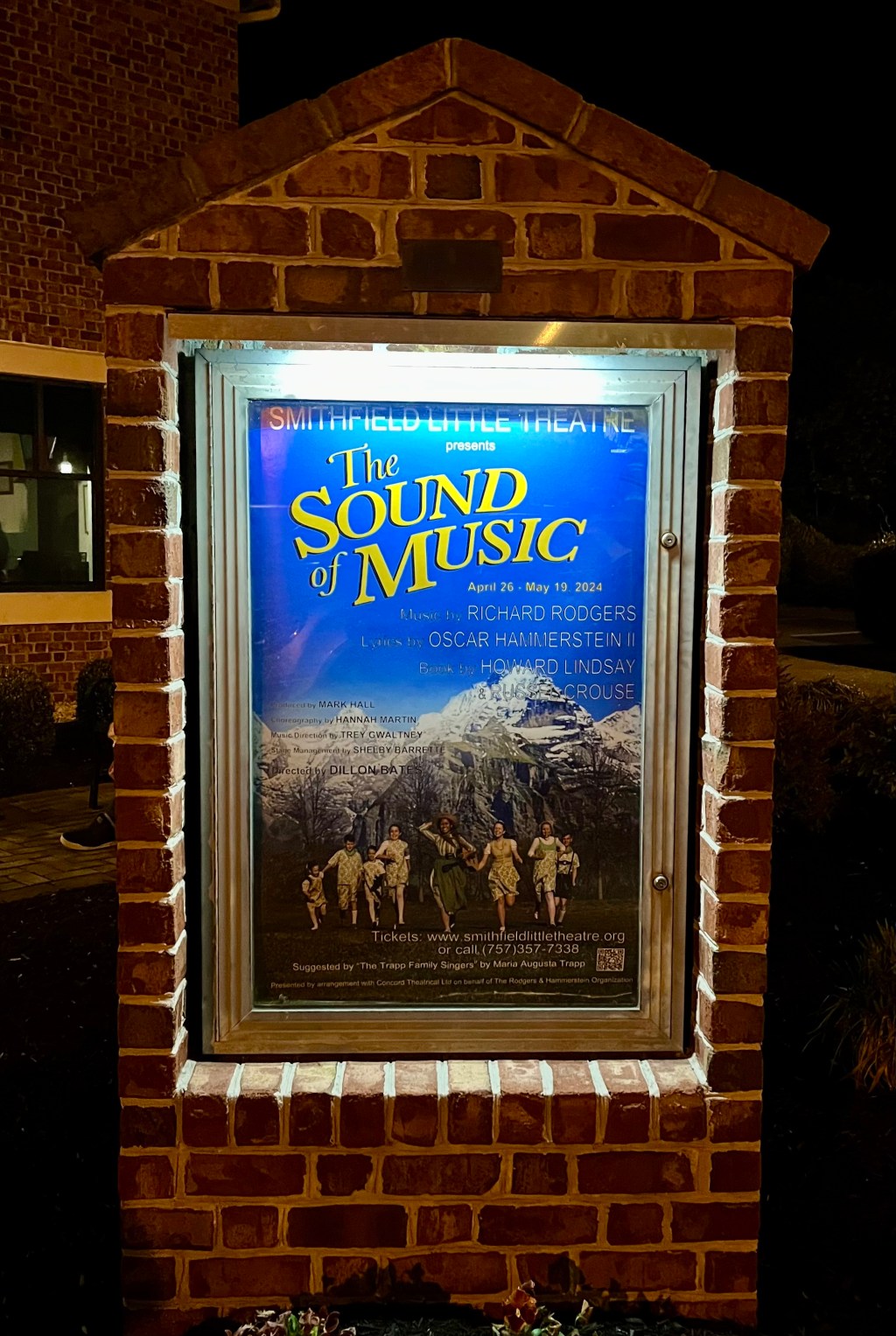
As we drove out to Smithfield Little Theatre, my wife and I were nervous. We knew that, while “The Sound of Music” is one of our favorite musicals, it is not exactly an easy show to put on, especially for community theater. We knew that (1) you need multiple strong adult singers to hold down the leading roles. We knew that (2) there were multiple big ensemble numbers which require many good voices to support the stars. We knew that (3) you need to somehow bring the hills of Austria (and multiple other scenes) to the stage. We knew that (4) you need a shocking number of costumes. We knew that (5) if the songs of the first act were just so-so, it wasn’t likely to get better in the second act, as in typical Rodgers and Hammerstein style, the second act is populated mainly with reprises. Oh, and we knew that (6) you need a whole flock of children who are going to commit to the act, dance and sing throughout the evening, and at a few moments of the show, you are going to basically hand the stage over to the kids, moments which have to be terrifying for the director. So yeah, a heavy lift to stage “The Sound of Music”, to say the least.
As it turns out, our trepidations were completely misplaced. Smithfield Little Theatre turned in one of the best community theatre productions we have ever seen! If you don’t have tickets yet – stop reading now and then come back to this article, because SLT has made it clear via their social media that they are just about sold out for the entire run. I’ll give you a minute…
…
Okay, gotten that taken care of? Let’s get into why this performance was so good. Spoilers ahead – but I’m pretty sure everyone who would be interested in reading this is familiar with the 65 year old story.
(1) Multiple strong adult singers for the leading roles? Check. Strike that – check plus. I know you’re first wanting to hear about SLT’s Maria, Monique Melchor. Can she sing? Heck yes. Can she act? Definitely. But what Melchor is able to do even better that those talents is bring the energy, the verve for life, the pure love for singing and the warmth of character to every scene that the role requires. She has a way of allowing the children to be the stars, while not taking anything away from her own performance.
But of course, Maria can’t do it alone. Hope Swindler, as Liesl, is wonderful. Her voice complements and harmonizes with Maria’s beautifully, allowing the Maria and children songs to really pop right off the stage and into your heart. Swindler is a nice complement to Jake Swery’s Rolf, and when she sneaks back into the house after her romantic tryst through Maria’s open window, her acting really starts to open up. No matter the scene, watching Swindler is not a bad option, as she is always in character and always doing something entertaining.
The Mother Abbess is a tough role, requiring both the appearance of the discipline of being a nun (and a nun in management) and the soft-hearted understanding of a trusted confidante. Oh, and you have to sing the biggest showstopper of the evening with “Climb Every Mountain”. Arna Majcher executes this wonderfully. Her voice fills the theater entirely as it crescendos, convincing Maria that she must follow this path to see where it leads, and providing the inspiration and direction for the rest of the show.
Captain von Trapp is a complex role, making the largest transition of the night, from hard-hearted Navy Captain who has repressed his feelings since his wife died, to loving father and husband. Andreas Zollos pulls off this trick beautifully. He comes across as so rigid at the beginning, blowing those whistle calls, that I wasn’t sure if he could believably turn it around within three hours. But, by the time he is choking up during “Edelweiss”, you will be quietly tearing up in your seat as well.
Bringing the levity into the evening is Adam Smith as Max Detweiler, that man who is always on time for dinner at his rich friend’s house. Smith is just right as the morally ambiguous Detweiler, willing to do whatever it takes for him to survive the coming Nazi onslaught. He shares a couple of well sung, well choreographed and fun songs with Grace Fitzpatrick’s Elsa Schraeder. Fitzpatrick, who we saw earlier this season in “The Prom” at PCT and was in one of our all-time favorites – “She Loves Me” – at SLT last season (which happened to help inspire the creation of the HRACT Awards), has a beautiful voice and plays the role of the Schraeder perfectly – i.e., not totally unlikeable, but somehow not really that likeable either. Here is to hoping we get to see Fitzpatrick in a leading role of her own sooner rather than later.
(2) Did the ensemble successfully complement the leads? Yes! This was one of the strongest ensembles we have heard. The level of harmony and sound coming off the stage when everyone was singing was remarkable, and that is a huge credit to the full band led by band/musical director Trey Gwaltney and the sound design by Don Curnutte. The nuns were an especially strong chorale as a group, and the four featured nuns (Majcher along with Lynn Bright, Joy Vernon, and the aptly named Madelyn Monk) who sung “Maria” (aka “How Do You Solve a Problem Like Maria”) in tight harmony were wonderful.
(3) Bringing the hills of Austria to a small stage in Smithfield? Success. The set, built and designed by Robert Cox, Steven Kellberg, Mike Hildreth, Matt Baranak, & Mary LeCompte, was a nice complement to the action on stage. A beautiful mural of the hills of Austria formed the backdrop behind the walls of the von Trapp family home for the base set, and then pieces were moved in and out to create the home’s porch, the abbey, and that courtyard in which the family is almost caught by the Nazis. The lighting package designed by Dillon Bates was also one of the best we have seen and had multiple tricks up its sleeve. First and foremost, they had to get the lighting right on the backdrop of the mountains, and use that lighting to indicate the time of day. They had lighting for the abbey in the first scene that looked like it was coming through stained glass windows in a very impressive manner. They had lighting ready for when the stage extended into the audience. The lighting hit cues perfectly when the actors walked around the stage. And, the darkness of the scene with the Nazis looking for them with flashlights was tense and created that sense of fear in the audience. This was really well done.
(4) So many costumes! Costumers Jan Clapp Bomar, Elaine Brown, and Pam Revill had their work cut out for them, and they nailed it! With so many iconic looks from the movie, each character seemed to have at least five different looks, from the children’s Navy garb to their curtain play clothes to the simple beauty of Maria’s looks to the fabulous dresses of Elsa Schraeder. Wonderfully done.
(5) Can you keep the audience engaged in the Rodgers & Hammerstein second act consisting of mainly reprises? Yes! Huge credit to Dillon Bates for his direction here. He successfully made the songs feel fresh and new each time with his staging choices, and kept the cast’s energy up throughout the play. And, he did it all with children, adding an extra level of difficulty. There are many scene changes during “The Sound of Music”, and Bates was able to keep the transitions from feeling awkward or too long. The choreography of Hannah Martin also deserves credit here. She did a fabulous job of creating dance numbers that were reminiscent of the film, but totally manageable on stage, that also felt natural and kept the audience in the moment. Oh yeah – she too pulled that off with much of the dancing being done by the children. Nice work.
(6) And the most dangerous of all propositions – do a show in which you, at times, hand the keys over to a group of children and hope for the best. Well… the kids absolutely stole the show, in the most wonderful of ways. The von Trapp children are at times formal, sneaky, cute, hilarious, scared, and smug – but most of all, they are wonderfully children. They are given enough freedom by Bates to be themselves on stage, which makes them believably what they are – just a group of (massively talented) kids, who want their dad to be happy. Oh, and they don’t want to be murdered by Nazis.
Their most impressive moment is in Do-Re-Mi, as they are slowly, and then very quickly, convinced that Maria is going to be a wonderful governess. The choreography of that song is so well produced and executed that you can’t help but grin like a total fool from beginning to end. And, as the song reaches its climax, the kids successfully somehow turn into a bell choir, each perfectly hitting their individual note in time with the song. Huge credit to Children’s Vocal Coach Karen Willard on getting that pulled off – we were so impressed.
Caden Wood as Friedrich is perfect in his role as the eldest son who is still a child but on the cusp of becoming a man. His brother Kurt, played by Tommy Gillette or Daniel Havlin depending on the performance, is hilarious to watch as he marches around, and somehow stands out especially during “The Lonely Goatherd”. Caroline Simpson as Louisa is the perfect troublemaker with a heart of gold. Brigitta, a role shared by Caylee Wood and Grace Wigginton, steals the show for a second when she perfectly delivers the news that everyone can see but nobody has been willing to say – that it seems like Maria and the Captain are falling in love. Marta’s plea for a pink parasol is wonderfully delivered by Blaire Walker or Natalie Board, depending on the performance. And Gretl, that tiniest of von Trapps, delivers her lines, and sings on key, with a confidence and stage presence well above her years, whether it is actress Amelia LaSalle or Aurora Melms at your performance.
While each of the von Trapp children is good individually, they are truly great when they are together, singing, dancing, or just interacting. As they each go upstairs to bed while singing “So Long, Farewell”, you will be moved to also wave and sing “Good Night” with the rest of the adult cast. It’s a perfect recreation of an iconic movie scene, and such a fun time.
My personal favorite musicals are those that center their story around an internal or interpersonal conflict, and then tag on the gravity of a larger societal problem. This is the type of story that is often shied away from by community theaters, as it often means big or multiple sets, large ensembles, and talented leads. Smithfield Little Theatre took on a monumental task in choosing to put on “The Sound of Music”, and they hit a home run. This is one community theater musical that is not to be missed. Bravo!
 HRACT Awards