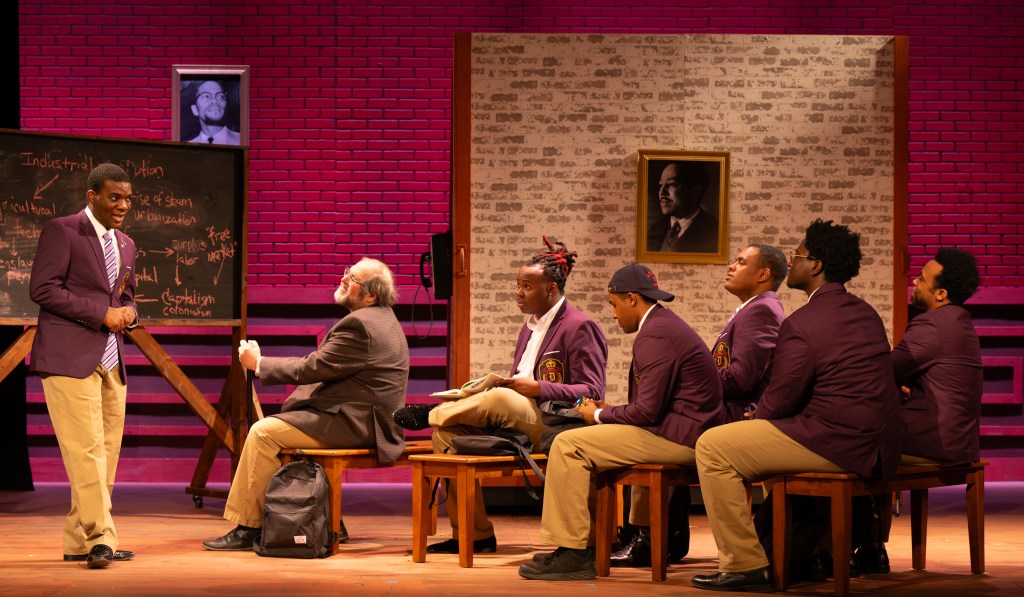
Photo courtesy of J. Stubbs Photography (https://jstubbsphotographyvb.com/)
A forecast of snow wasn’t going to stop us from getting to the Little Theatre of Norfolk on Friday for the opening night of “Choir Boy,” a powerful story about a gay teenager at an all-boys boarding school written by Tarell Alvin McCraney (who also wrote the Oscar winning movie “Moonlight”). The play leaves no doubt about the issues we are going to be struggling with all night from the get-go, as it starts with our main character, Pharus, having several gay slurs whispered in his direction while he sings the school’s song at a graduation ceremony. Upon returning the next fall, Pharus (now a senior) and his classmates must deal with the fall-out from that event, and what happens over the course of their senior year.
Calvin Graves Jr. is powerful in the role of Pharus. He was subtle when needed, dramatic when called for, and always provocative. Pharus is not perfect – he makes multiple miscalculations and mistakes throughout the play – but that is what makes him come to life as a character. And Graves is a fantastic storyteller, keeping you pinned to your seat as he tells you a story about his experience as a child in a barbershop where a kid he considered his friend turned on him because he was gay, and the men in the barber shop didn’t say anything, but implicitly took the friend’s side.
And this perfectly embodies the biggest message I got out of this play – the importance of being bold and forthright in your ally-ship. You never know when standing up for someone or even just against something will make a difference. Imagine if one of those men in the barbershop had set that kid straight and said – “we don’t talk like that – we build each other up”. That might have made such a difference in Pharus’s life. And while they each have different side plots or stories, I find that pretty much every supporting cast member in the play is there to show a different level of ally-ship (or lack thereof). Pharus’s roommate Anthony, played wonderfully by Ra’Melle Marshall, is the closest we get to an ideal ally, ready to go to war to support Pharus, fully accepting and embracing him. Headmaster Marrow (a strong performance by Don-Michael Smith) definitely considers himself an ally and mentor, but his constant advice to Pharus basically to act less gay reveals the limits of his acceptance.
Mr. Pendleton, an old school teacher and the only white character, played by Juan Gelpi, demonstrates a confusing ally-ship, and introduces race into the picture too, as we are told that he marched with Martin Luther King Jr, and yet he makes several off-color remarks that seem to implicate him in having biases against African Americans (but maybe just as a way to be provocative and force discussion in class… but maybe not)? This unclear character is perhaps meant to show the ambiguity of going through life, trying to determine who you can trust and who you cannot, and I think Gelpi did a nice job with that.
Bobby, played by Chris France, is the opposite of an ally – he is the one who is clearly throwing hatred Pharus’s way. France is conniving in this role, always looking for ways to subvert Pharus, while exploiting the fact that the Headmaster is his uncle. As any good bully does, Bobby has a sidekick, Junior, played by Job Jones-Noel (who is making a career out of roles where he is in the wrong place at the wrong time – see our “Sweeney Todd” review here). Junior, although not showing outright hatred, embodies the peacemaker/silent role, seemingly trying to stay on the sidelines of most of the major issues brought up.
Then there is the enigma that is David, played by Jacar McNeil. Outside of Pharus, David is certainly the most complex of the characters, juggling the demands of his parents, his desire to become a reverend, and his internal struggle with all that is happening around and to him in school. This is a really difficult part to portray, as David’s actions are driven by internal pressure and pressure from offstage parents, and thus the burden of demonstrating that relationship and all that emotion falls entirely on the actor’s shoulders – and McNeil is more than up for the challenge. There are also several musical numbers (the play is called “Choir Boy”, after all), and McNeil’s voice rises to the forefront of each song, showing depth and power. Let’s get McNeil a leading role in full-fledged musical soon people!
Filling up the stage throughout and the sound in the musical numbers are Elijah Ramsey and Derrion La’Zachan Hawkins – both of whom you should make a point to watch some when they are on stage. They have several little moments where they have funny reactions or interactions with each other or other cast members that are well worth the effort to sneak a peak at.
Getting those little interactions throughout the show to consistently happen, while not taking away from the main plotline, is a trick on its own, and one that first-time director Tré Porchia gets just right. Porchia gets his actors to demonstrate the depth of their characters especially well in the scenes where they are calling home – the one-sided conversations that the script calls for provide the opportunity and challenge for the cast of communicating the emotions, pressures, joys, and disappointments of each student’s relationship to their parents while the audience only sees one side of the conversation, and Porchia gets this cast to display that beautifully. Porchia’s blocking is interesting but not distracting, he successfully integrates several cool technical effects, and most importantly, he gets the feel of the show just right. There is a clear comradery on stage between the actors, which helps them tell this emotionally wrought story in a fully trusting environment, and Porchia deserves a lot of credit for making that happen.
Meanwhile, his technical staff also came through with top-notch work. Brian Cebrian’s set, with multiple pieces that rolled on and off stage, multiple backgrounds, and a very cool locker room/shower scene set up (yes, nothing good can come from having a shower scene in a show about the one gay kid at an all-boys boarding school), hit the mark dead on. And this had one of the most impressive lighting packages we have seen, thanks to the work of Derrion La’Zachan Hawkins. He brought us multiple different lighting tricks, which interplayed with the set, and the emotion of what was happening on stage, perfectly. This was the most effective use of fog machines we have seen which, along with the lighting, created the perfect feel for shower scenes. Really well done.
“Choir Boy” is less a “coming-of-age” tale, and more a “just-survive-this-part” tale. I think that Pharus said it best, when he was arguing with Bobby in class about what made Spirituals (the songs that enslaved people would sing in the fields) important. Bobby believed that what made them important was tied to the hypothesis that there were encoded messages within the song lyrics about how to escape, while Pharus argued that the songs were important for exactly what they were on the surface – wonderfully constructed songs, a way for your mind and soul to escape the day. Whether he realizes it or not, this is exactly what Pharus strives for – to be recognized as mattering because of who he is, period, and not because of some put-upon story about why he matters.
And with all that to talk about on the drive home – we had to rush out to beat the snow (come on snow – couldn’t you come on Sunday night to get us out of work? Friday night snow does nothing for us on that front).

