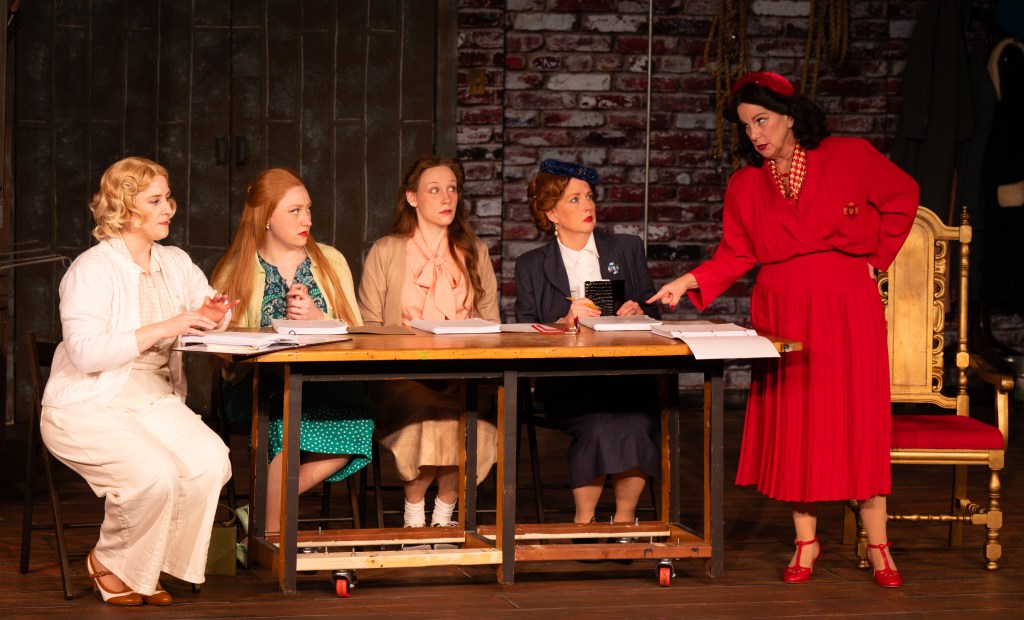
Photo courtesy of J. Stubbs Photography (https://jstubbsphotographyvb.com/)
“Into the Breeches” begins and ends with only the ghost light burning on stage, a time honored tradition of leaving a single light on in a playhouse when nobody else is there (legend says this is to keep the ghosts away, although its real function may be more safety-related, to keep anyone walking into the dark theatre from accidentally tripping off the edge of the stage). In this show, however, it is a poignant representation of the glimmer of hope being provided by our characters as they take on the task of keeping art alive on the home front during World War II, ensuring spirits stay high for those still in the States.
Of course, this won’t be an easy task, as the plays this based-on-a-true-theatre theatre has chosen for its season are heavily male-dominated (specifically, the “Henriad”, i.e., Shakespeare’s Henry IV and Henry V, presented together), and most of the men who were part of the company are now off at war. Even the theatre’s much revered director, Andrew, is off on the deck of a Navy ship. But his wife, Maggie, played by Ariel Miranda Conkel, is ready and willing to push forward with the production. Conkel is excellent in this role, showing Maggie as determined yet kind, imperfect yet striving to be better.
Maggie’s first task is to sell the theatre’s leading lady, Celeste, on taking on male roles. In one of our favorite comedic performances of the season, Elizabeth Dickerson absolutely stands out as she dives right into the diva that is Celeste. She is hilarious, commanding the stage anytime she is on it with her dramatic movements, perfect pauses, and constant tantrums. She drags her throne (yes, literal throne) around the stage anytime she must sit, and consistently delivers excellent punch lines – notably “they’ve internalized the cods” (you’ll get it when you see it). And this isn’t a one-note role, as Celeste is the rare caricature of a role that ends up having a satisfying character arc, which Dickerson navigates with ease.
Maggie then has to sell the board of the playhouse on continuing with an all-female cast, and so she goes to the leader of the board, Ellsworth Snow. Ellsworth (HRACT Award nominee James McDaniel, in a role that perfectly fit his particular cadence of delivering lines) is not so keen on the idea, but comes around quickly when Maggie finds the right button to push – i.e., his wife, Winifred, who is interested in taking on a role in Maggie’s production. However, rather than submitting to the typical trope of “happy wife, happy life”, this play actually shows the relationship as having love and support from both sides of the Snow’s relationship – with Ellsworth really and truly supporting his wife in her endeavor, which is a nice change of pace from what might be expected of a rich 1940s husband. And for her part, Wendy Nelson’s Winifred pulls off the tough trick of turning from a very bad actress into a funny Groucho Marx style comedic role by the end, definitely making Nelson deserving of more mention than just “rounding out the cast”.
Maggie’s casting call to fill out the Henriad’s troupe gets two respondents – June, the young and self-proclaimed ingenue who is constantly looking for ways to support the war effort, and Grace, a newcomer to the town, who, with her young son, moved into her mother-in-law’s house when her husband shipped out. Cristina Rose, who recently impressed in “Little One”, plays the naïve and optimistic June, an impressive about-face from that very dark role of Claire. And Meredith Owens as Grace has the difficult task of making the audience believe that, while raw, she has extraordinary acting potential. Owens succeeds not only in that task, but also in providing a lot of the emotional punch for the show, while not seeming over-wrought or put-on.
With such small turn-out for her casting call, Maggie isn’t sure she can pull off the Henriad, until her backstage crew convinces her that they are worthy of the stage too. Ryan Jennings is the trustworthy and competent stage manager Stuart who becomes the only male in the show. And HRACT Award winner Salem Rogers plays the (by all accounts) excellent costume designer Ida, who is perhaps even better in the spotlight. Their individual stories add layers to the audience’s understanding of what the times were like on the home front of World War II, and they each deliver powerful messages in strong all-around performances.
I’ve focused a lot on the individual performances in this show in this review – and that’s because the acting was truly excellent. Director Connor Norton gets this cast to deliver a performance that feels totally natural and familiar – while still being surprising and funny. Definitely one of the better acting ensembles we have seen over the last couple of years. And the best moments of this show are when the cast is together on stage, an embodiment of the community they’ve created by doing a play in such difficult times, each bringing their different talents and experiences with them, and each getting something different out of the experience. I love that Maggie creates such a supportive environment for her cast – one that embraces and supports what is going on in each of their lives outside of the theatre rather than shying away from the outside world. And isn’t that what community theatre is all about – the community created? I know that is what will “linger” with me from this show. So, let’s support this rag tag group of World War II actors by taking a page out of June’s book and rationing those tomatoes rather than throwing them.

