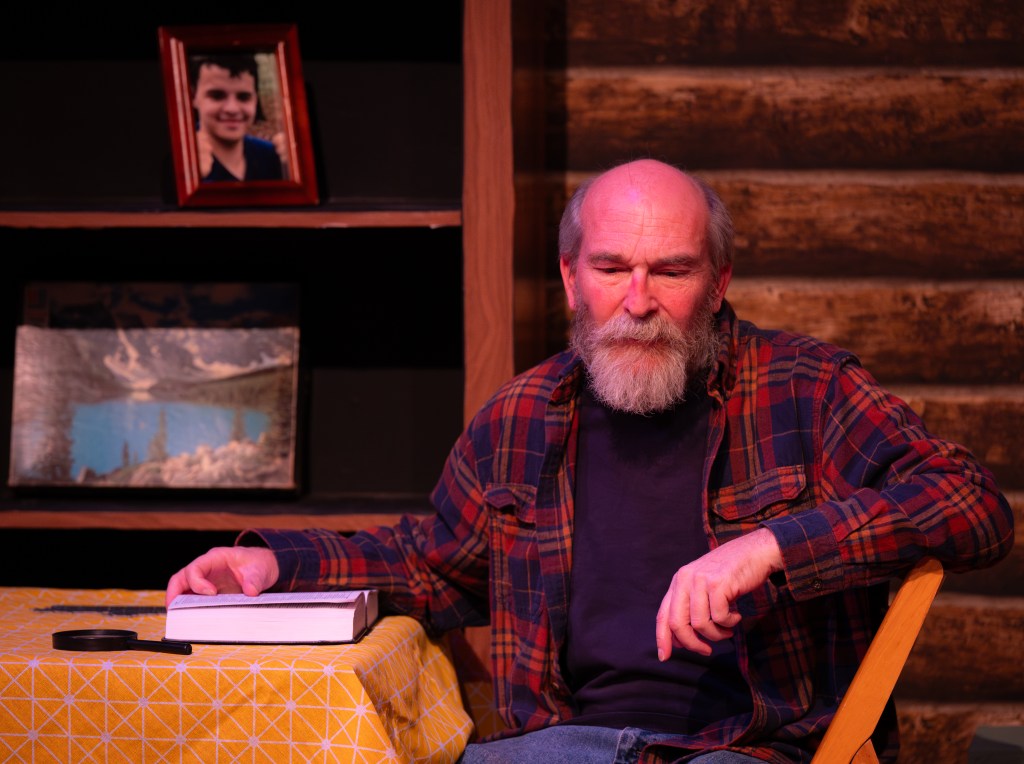
Photo courtesy of J. Stubbs Photography (https://jstubbsphotographyvb.com/)
As I walked into the Generic Theater on Sunday afternoon, I had the same thought as Daniel on stage – so, where is the shock treatment equipment? We would soon find out that Daniel, played by the fast-rising and talented Lucas Guzzo, has indeed walked into a gay conversion camp (as promised by the marketing material for “A Great Wilderness”)… but, he is assured by “camp counselor” Walt (Jonathan Hite) that this is not that kind of gay conversion camp. What kind of gay conversion camp is it? Walt explains that this is a safe space, where his number one goal is to ensure Daniel’s safety, while also talking through the feelings Daniel is having in an attempt to best determine how to deal with those feelings.
Ok, I’m not going to bury the lead here – although this style of gay conversion camp might not inflict physical torture, the mental torture of having society tell you that something is wrong with you, something you cannot change, and something that is an important part of you, is just as horrifying. And this play absolutely gets that point across. Playwright Samuel D. Hunter is giving the audience a chance to see how people can talk themselves into these sorts of things being good ideas by putting human faces, with relatable problems, on the people who run them. And he does so extraordinarily effectively, reminding us that we are each the hero of our own story, whether or not others would agree.
Take, for example, our main character (I think “protagonist” might be too kind), Walt. Walt is in the twilight days of his working life, and he knows it. He has spent twenty years “helping” many boys (which, in fairness, he does seem to have truly convinced himself he is helping), but now he is constantly forgetting things, recently fell and had to call for help, and is dealing with the fact of his impending retirement. His ex-wife, Abby, has helped set him up with a room at a “home”, and is coming up this weekend with her husband to help him pack up the old cabin he lives in. Walt, as are many of the characters in this show, is in a very sympathetic situation for a decidedly unsympathetic character. And Hite does a fabulous job in this role. He shows that denial of the regression of his faculties which you see in many a prideful near-retiree. You can see his worry about what his legacy will be, his fear of loneliness and loss of purpose that will come with retirement. And he is always consistent, that what he wants most for the boys is for them to be safe, and that he has done good work in his life (he uses some backwards logic to get there, but that is where his comfort comes from). He is progressively seeking more and more reassurance throughout the play that he has in fact done something good with his life.
And that reassurance is supplied by Abby and, to a greater extent, her current husband (and former co-camp counselor) Tim when they show up to help pack up the old place. Lisa Kearns, playing Abby, has the tough task (and does a nice job) of showing a complicated and frustrating, but still caring, relationship with her ex-husband, while also being the character who would probably consider themselves as the most pragmatic of the group. And Tim, played by Bruce Hermans (who we last saw leaping out of a coffin in “The Viewing Room”), is the embodiment of reassurance, providing the other end of the perverse positive feedback loop that Walt is in.
The plot hinges on Daniel (that boy who Walt et al are in the business of “helping”) going out for a walk in the woods… and not coming back. His mom, Eunice (played by an appropriately emotionally distraught Christina Wiley), shows up, and starts wondering aloud if she made the right choice to send Daniel here (unfortunately, she is only upset about it in the “you let him get lost” sense and not the “I should accept my child as he is” sense). At one point, Eunice cries “I don’t know what to do” – and all I could think was “truer words…”.
Meanwhile, we get some interspersed scenes from before Daniel went on his walk, where we see Daniel and Walt talking. These are some of the most fascinating, as Walt is not pushy about his agenda, and we get some backstory on both characters. Daniel opens up to Walt and shows him the heirloom tomatoes that he raised in his garden and brought with him. Apparently, tomatoes that aren’t mass produced can be all sorts of colors and sizes – and Daniel loves the idea of creating such different and fascinating tomatoes if you don’t let society decide for you what a tomato is supposed to be. This hobby is in stark contrast to Walt’s, which is reading the dictionary, something that tells you exactly what a word is supposed to mean (seemingly the only book in the house, other than the Bible), and I believe represents Walt’s need for logic and semantics to convince himself of the benefits of what he has dedicated his life to.
Of course, when Daniel goes missing, the authorities get involved, and we are introduced to the ray of sunshine that is Sheryl Harris as Park Ranger Janet. Janet brings a tiny bit of levity to a play that badly needs some to cut the tension (the only other break is provided by Paula Vaiden Hill’s funny and timely voiceovers for the marketing video which the retirement home sent to Walt). Harris feels exactly how you might think a Park Ranger would react to the situation (less than panicked at the beginning, and progressively ramping up search and rescue efforts as time passes). However, I think the real value of the character is in how she is representative of the danger of society allowing something like gay conversion therapy to become normalized. Janet states that her initial reaction upon hearing about Walt and his camp was disdain (after all, she says – falling into a trap often seen in the real world – she knows some gay people, and has no problem with them, and they seem happy for it). But, after meeting and getting to know Walt, Janet comes to like him as a person, and that slowly erodes her distrust. Which then leads to her pandering to Walt’s wishes of “keeping it quiet” when Daniel gets lost, which leads to not making the situation an emergency and bringing it to light until much later.
As it becomes clear that Daniel’s situation is becoming more dire, Walt’s mind also begins to fail him quicker and quicker. The fires of his life begin to close in on him, and this rapid transition is brought to life very well by both the actors on stage and the direction they were given on how to interact with each other and the set by director Victoria Blake. Although the stage doesn’t actually change, the staging begins to make the theater feel very small and claustrophobic. In an interesting turn, as Walt begins to lose his grip on reality and is no longer able to rely on his logic for comfort, he begins to find the actual horrific reality of what he has spent his life doing, and the body count it has contributed to that he seems to have intentionally ignored. He turns to, of all places, his dictionary for answers, and then, perhaps realizing he can no longer logic his way out of the hell he has put himself in, or perhaps just being absent-minded from his weary and old brain, he burns the dictionary as fuel for his stove. That leaves him with only the Bible to turn to for forgiveness, and the audience with more questions than answers on what has happened, and what will happen next.

