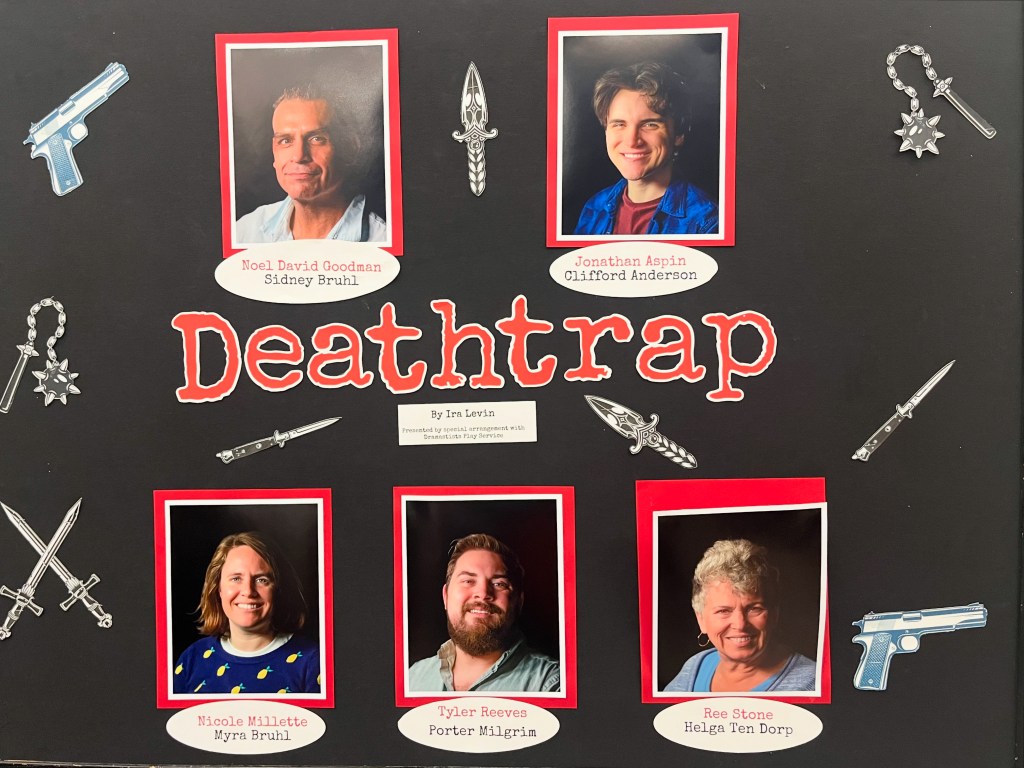
In our family, we love a good “for entertainment purposes only” bet – we try to guess what configuration the stage will be at Generic Theater, place wagers on how many empty seats there will be when we go to LTVB (spoiler, it is always less than five), and try to prognosticate how the Green Room will be decorated at LTN. Walking into Williamsburg Players for “Deathtrap” on Thursday, it was immediately obvious what the night’s speculation would be – how many of those weapons will come off the stage walls to be used in the play’s action? Once bets were placed and stakes were made, I began to settle into my chair, when I noticed the typewriter on stage, and felt a sudden chill down my spine – after seeing “Misery” at LTVB earlier this year, I’ve grown quite suspicious of a stage with a typewriter, and so, I made a mental note to myself to keep my head on a swivel and to trust no one.
Of course, I can never follow my own advice, and when the onstage lights flicker on (yes, actually flicker – a nice detail), playwright Ira Levin’s extremely clever script immediately drew me in, with its smart, funny dialogue and self-referential style, delivered on a detailed and well appointed set with plants outside the French doors on stage right, a stairwell peeking out from the entryway upstage center, and clever posters of fictional plays, all thrillers, throughout. Those posters, as well as the weapons on the walls, are props and memorabilia from the career of our main character, playwright Sidney Bruhl (played by an appropriately erudite Noel David Goodman). Unfortunately, he seems to have hit a bit of writer’s block, and has taken to teaching writing seminars to supplement his wife’s apparent independent wealth so as to maintain their upper class lifestyle. Worst of all, one of his students has sent him a copy of a script looking for feedback – and it is AMAZING. Like, best script ever. Sidney is immediately jealous – but his wife, Myra, thinks this could be an opportunity – give this student advice, yes, but suggest that, in return, Sidney get some small percentage of the royalties.
Sidney, being the thriller writer that he is, considers taking things one step further – after all, why only get a small percentage of the royalties, when he could take them all? He is the only one who has read this script, and seems to be the only one (other than the author) who knows of its existence. As he considers this out loud, Myra (played by Nicole Millette) becomes more and more disillusioned with her husband, trying to talk him out of his rapidly developing plan. Millette and Goodman are excellent in their interactions with each other, coming across well as the middle-aged New England wealthy couple, with their references to dinner parties and the neighbors interrupting the nefarious plotting. And when Sidney arranges for this student to come to their house to “talk through the script”, his intentions are still wholly unclear to Myra and the audience – an ambiguity that can be afforded from living in a house with at least fifteen different murder weapons already poised for action.
When the student arrives, we were pleased to see it was Jonathan Aspin in the role, who we found very compelling as Seymour in WP’s “Little Shop of Horrors” last season. Playing Clifford Anderson, Aspin arrives naïve and with hands shaking – a nervous young man excited to get advice and attention from a role model – and Aspin does a nice job conveying this.
Now – I don’t want to give away too much plot, so I’m going to leave it there. I do, however, have to mention our other two characters – one being lawyer Porter Milgrim, played by Tyler Reeves, pulling off the “dull but sharp” character to a tee. And finally, Ree Stone plays Helga Ten Dorp – a seer who has recently moved from northern Europe to the cottage next door. Stone absolutely steals the show in every one of her scenes, commanding the attention of everyone, on stage and off. She is hilarious, with thoughts bouncing off walls and objects into her mind in a senseless order that feels like how a good (or at least a talented fake) augur should act, as she senses many different things, predicting the future left and right with utmost confidence. Stone gave the play and the part such a lightness, but also hit the right notes in terms of the gravity of the things she was predicting. Really well done.
The map may be drawn by the playwright, but it is the director who steers the ship, and Debbie Noonan did a fantastic job hitting all the right notes at the right times. She very successfully navigated the cast and the audience through the thriller genre – through stage fights and tension, and then lulling the audience into a sense of comfort right before what was one of the best jump scares we have seen on stage (the nice lady to my right literally grabbed me in the moment, and it seemed as if you could feel the whole theatre jump ever so slightly out of their seats as people audibly gasped). A delicate balance between funny and scary was needed, and Noonan executed this masterfully.
Not going to say how many of those weapons did in fact come off the wall – but I’m sure you will have a good time finding out.
 HRACT Awards