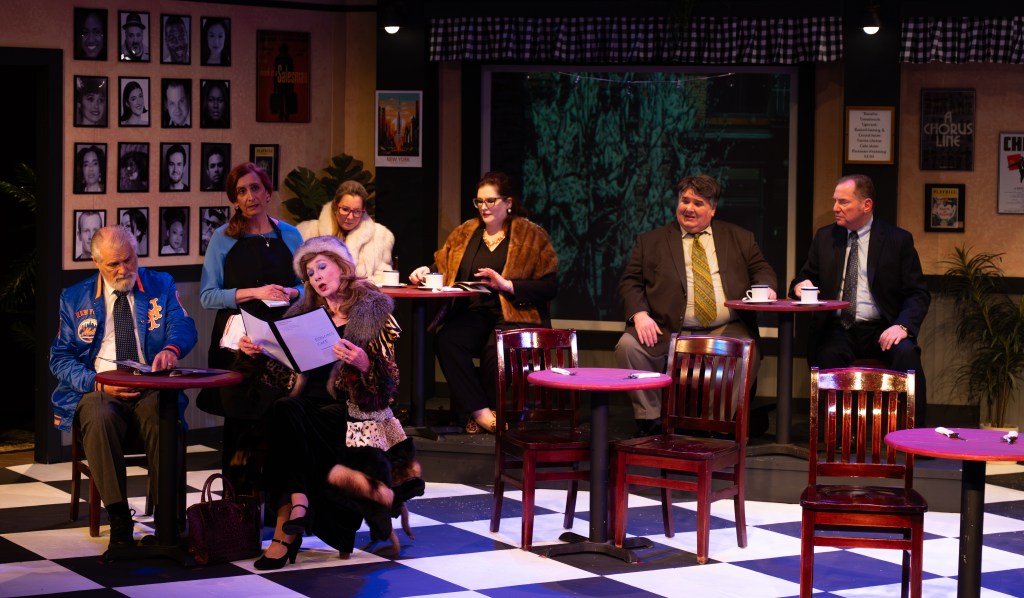
Photo courtesy of J. Stubbs Photography (https://jstubbsphotographyvb.com/)
As we sat down in our seats at LTVB on Friday night, the first thing we did was check how our March Madness brackets were doing (unsurprisingly, not well). The second thing we did was be amazed by the restaurant set out in front of us. My wife turned to me and said “I like the floor, I like the knick-knacks, I like how the walls are decorated with pictures of famous people who have eaten here and posters for musicals, I like how you can see out the large front window onto the street (which later includes some cool projection effects), I like how you can see into the hallways on either side of the stage, and I like the string lights.” And I couldn’t agree more – in fact, I’m pretty sure we had Thanksgiving dinner at this restaurant once when we went to see the Macy’s Thanksgiving Day Parade a few years ago (where they gave us free ice cream, similar to the free cake that Bernie and Zelda, the proprietors of this restaurant, enjoy dishing out). I also noticed that Cookie Time clock, which I’m pretty sure was used on the set of “Misery” earlier this season – showing it can be fun in addition to creepy (a surprisingly versatile clock). Fabulous job by set designer Mike Hilton and his team here.
Of course, a set needs a cast to inhabit it, and this group is able to make you feel right at home, moving from conversation to conversation in the restaurant. The aforementioned Bernie and Zelda, the owners of the so called “coffee shop” – it really seems like a restaurant – are played by Brian Cebrian and Dorothy Shiloff Hughes, who pull off the welcoming small business owner act with aplomb. In fact, we are introduced to Cebrian’s Bernie when he refuses to let struggling South African playwright Soloman Mantutu pay for his meal. Mantutu, however, is too proud to accept this gift with grace, and he pesters his way into the community that surrounds the restaurant. Ra’melle Marshall, as Mantutu, does a really nice job of pestering, but not to the level of annoying the audience. Rather, he is able to endear himself to the group. So too is Cassidy Corbett’s Megan Woods, who has been sent to New York to try to become an actress at the behest of her mother (funny, since the storyline usually goes the other way, with the parents pushing for reality against the child’s fantasy).
The most famous member of the group is Mickey Fox, a Jewish comedian who is doing a show nightly at the theatre next door. This is likely the largest role of the show, and is the beneficiary of many of author Neil Simon’s most clever and quick-witted lines. Luckily, LTVB has HRACT Award nominee Steven Meeks in the role, and he is able to completely fill the big personality that is Mickey Fox. Meeks has excellent timing in delivering his one-liners, and strong cadence with the other cast members – even the smarmy laughter of John Robert Moss’s Andrew Duncan, a producer trying to sign Mickey to a role in London. Mickey is what you always imagine a comedian to be – constantly cracking jokes and always knowing exactly what to say and how to say it (I’ve never heard someone say “chicken livers” with such verve for the dish) – that is, right until his brother Harry, played by Bob Cohen, shows up. Cohen and Meeks’ awkward interactions feel very real for two (not exactly estranged, but certainly not close) brothers. And Meeks’ interactions with something of an equal in star actress Bessie, played by the cool and confident Erica Majer, also seem just right.
The play takes a turn when Ann Heywood (as Rayleen Browning) walks in wearing a wild fur coat with her silent husband Charles, played by Marc Dyer. Heywood is wonderfully hilarious, commanding the stage completely with a swagger very few can muster, as Rayleen is completely in her own world, and Charles is… just along for the ride. Unexpectedly, Rayleen becomes the emotional center of the show, with Heywood’s performance and role leaving us with the most to talk about on the drive home.
Rayleen’s wild fur coat, along with the other costumes, are wonderfully put together by costumer David Prescott and seamstress Lavina Brewster, from the nice suits to the working outfits of the cast members who take turns manning the coffee shop. In addition, they came up with some excellent outfits for our resident wealthy theatre-goers (makes sense since this coffee shop is, after all, just 45 seconds from Broadway), Arlene (Beth Buchanan) and Cindy (Deena B. Sasser). The play takes place over four distinct scenes, and each cast member is well-appointed with different outfits for each scene – but the dresses that Buchanan and Sasser wear really stand out. Not to be outdone by their outfits, Buchanan and Sasser are extremely amusing to listen to as they dish about whatever show they have just seen – and then just as amusing to watch and listen to as they notice the real-life theatre happening in front of them at the coffee shop. Buchanan has perhaps our favorite line of the play, when she says, in perfect rhythm, “I need to go home, but I want to see what happens next” – something that we, as people who often make up stories about the people we don’t know at the table next to us, totally understand.
The attention to detail in many aspects of this show is what really stood out to us, a tribute to director Jeffery Seneca. The crew put snow on people’s coats before they walked into the winter-time scene. The cast members would pretend to be casually listening in to the other cast members’ conversations. The set builders considered every angle that somebody might be seeing the show from in building their set. And you know what? That attention to detail is a fitting tribute to the show itself, which speaks to the little kindnesses that people do for each other, because they take the time to notice one another and build a community from the ground up. I hope you all get the opportunity to find your little coffee shop 45 seconds from wherever you work/live/play, because it is having people around you who care about each other than makes life worth living.
 HRACT Awards