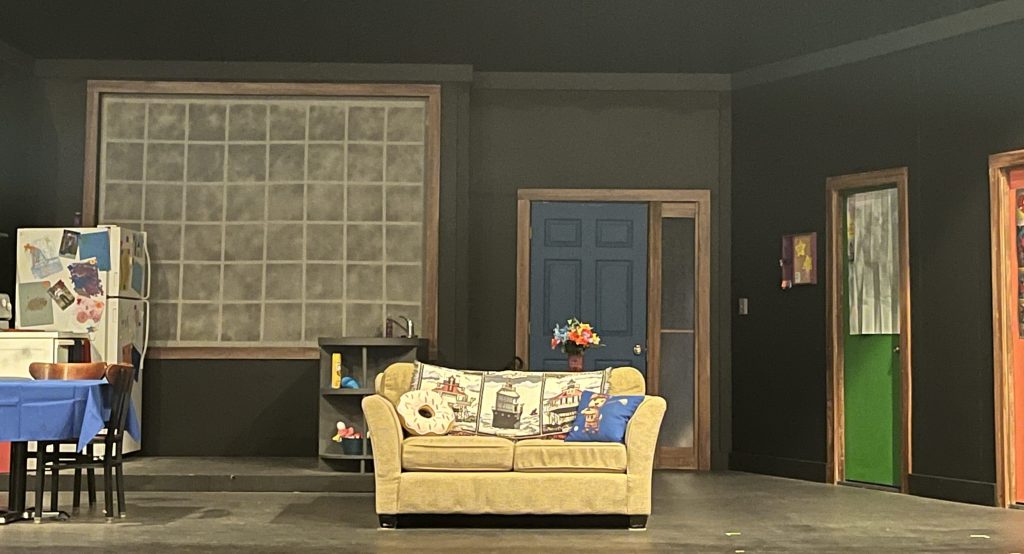
“A society should be judged by how it treats its most vulnerable members.” This line, delivered in an aside directly to the audience by Jack, the social worker in charge of the four intellectually disabled men living together in the acceptable-if-not-luxurious apartment in which this show spends the majority of its time, ensures the intent of this play is not left up for interpretation.
That intent is important, because this show puts a cast of non-disabled people on stage, many portraying characters who are intellectually disabled. That is a risky proposition, as it could come off as callous or insensitive. But – in this show – it is clear from the curtain’s rising that the intention is to provide a window into a world that many people may not even realize is happening around them, and to not just create caricatures of individuals – but rather, give them full personalities, with thoughts and feelings, accomplishments and motivations, and small and large problems, just like any well-crafted character in a play. And the intention is to drive action amongst the audience to make society better – from the tiniest interaction (like not taking advantage of a customer at a supermarket or an employee at a movie theater), to the largest (like influencing government policy).
So, with that context, I bet you are thinking – man, this sounds like one heavy evening. And you wouldn’t be wrong (see the “heartbreaking” in my title) – but while those heavy moments do permeate the show and provide depth, we haven’t touched the “heartwarming” side yet. The performance is filled with wonderfully fun vignettes of what feel like real interactions in these characters’ lives. The script is chock-full of lines that you will be quoting to each other on the ride home – our personal favorites included “rats are sneaky – that’s why people say ‘you sneaky rat’” and “if we can’t have cheese, I’ll go on a hunger strike” (as a dairy lover myself, I really get that one).
Director Dillon Bates did a fantastic job in the casting of this show and the direction, ensuring that each character feels real rather than put-on, and getting the pacing of each scene just right (something that is to be especially admired for having come together already by the time we saw the show on opening night). The acting is superb from the top to the bottom of the Playbill. Lawrence Nichols did a fantastic job as the constantly anxious Arnold, trying to manage his coworkers who are constantly taking advantage of him while he can’t help but create new plots and intrigue (and threatening to run away to Russia). When Robert Torres’s Norman is able to stop thinking about the donuts he has brought home from his job, he is consumed by the thought of having a romantic relationship with Vivian Ruiz’s equally interested, flower-in-her-hair innocent Sheila. Rai Gaines’ Lucien may be the least able to communicate his feelings in a traditional way, but his ability to convey the difficulties of navigating the welfare state is extraordinary. And Tyler Reeves’ turn as amateur golf pro (you’ll understand that contradiction when you see it) Barry involves a deeply emotional scene around his father in which he barely says a word – perhaps the most difficult and successful acting of the evening.
While each of the four are dealing with the outside world and their individual problems, it is in their interactions with each other that you just can’t help but fall in love with them, and by the end of the first act, the audience is rooting for them, worried about them, and ready for the intermission to end quickly to get back to the story. The escapades they get up to are massively fun to see play out on stage. Daniel Garwood’s Jack (that social worker I mentioned in the first paragraph) provides us with a bridge into their world, giving us the necessary background, while also being a fully-fledged character in his own right, showing the struggles and burnout that can come with being a caregiver. And Lyra Hale shows off her range, playing a plethora of one-off characters, filling out the environment that the group lives in.
Jack notes towards the end of the show that the way he sees it, for most of us, life moves forward, while for the intellectually disabled, they will always be in one place. I think I see it differently – these people are not stuck in the same place forever – rather, they are living in this very moment more fully and completely than most of us ever can (which, by the way, lends itself to the stage incredibly well – as the goal of any show is to whisk the audience away to be completely engulfed in the world happening on that raised platform). There is incredible joy in living and feeling the emotions of each moment so deeply. Some might say that being so immersed in the here and now is a simple view – I’d argue it might be the most complex.
 HRACT Awards