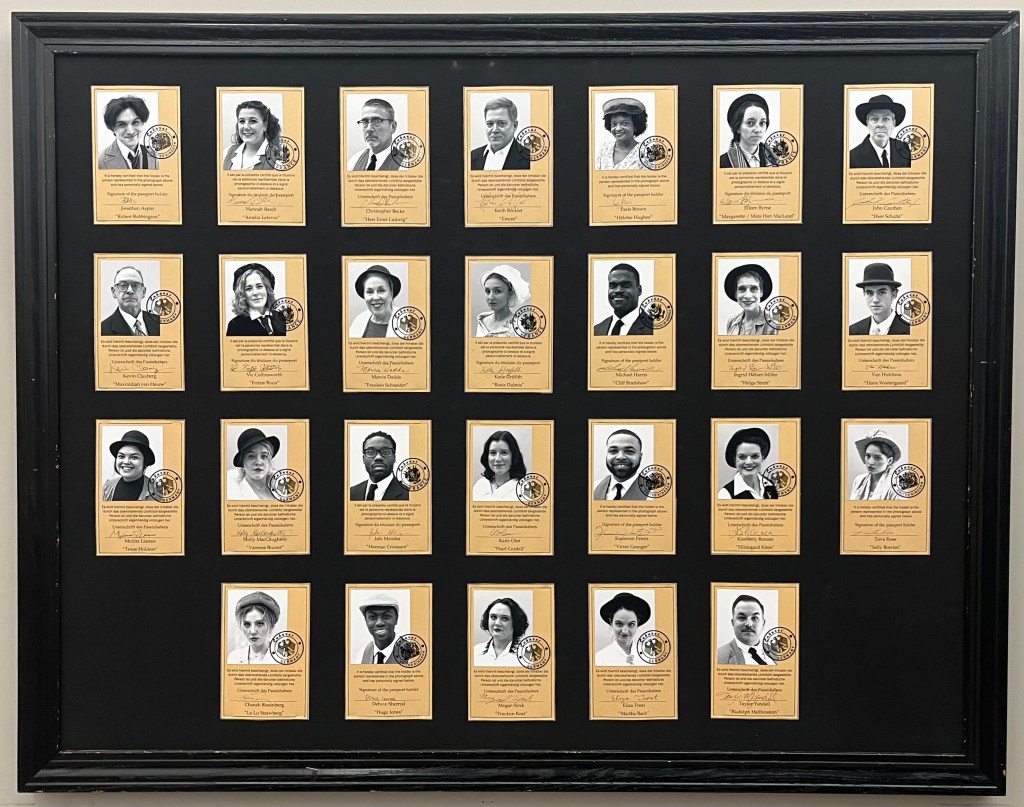
Four doors, two staircases, and curtains all around – the stage at Williamsburg Players for their production of “Cabaret” has many ways on and off, both inviting and haunting, an appropriate backdrop for the show about to play out before your eyes. Before you know it, the stage is filled with the cast of the Kit Kat Klub, welcoming you to the show and Berlin in the 1930s, which apparently was filled with sparsely dressed young people looking to practice free love (for a price).
The unquestioned leader of the show in the Kit Kat Klub is the Emcee, who also is, by extension, our master of ceremonies for the story that takes place outside of the Klub. Our first look at the Emcee (and the rest of the cast of the Kit Kat Klub, in their collection of lingerie-based costumes) is in the impressive and fun opening number, “Willkommen”. Keith Bocklet (nominated for an ACT-y for his role as King Charles in “Pippin” just a couple months ago) takes on the role of Emcee in this production – and is truly magnificent. He throws himself entirely into the role, with an over-the-top German accent, a look just short of drag, and a slowly but steadily creeping foreboding to his facial expressions. Bocklet leads the ensemble songs well, standing out from the crowd while also feeling like he is in charge. He sets the mood of the stage, watching most scenes from a dimly lit perch above the action, and is perfect as he becomes increasingly involved in scenes that aren’t directly about him as the story gets darker. And Bocklet knocks it out of the park with his final solo number of the evening – “I Don’t Care Much” – a devastating and gutting performance, which, like all of the Emcee’s songs, indirectly follows the actions occurring in the immediate plotlines, while also reflecting the political changes happening in Germany in the 1930s.
And the star of the Kit Kat Klub? That would be the beautiful and talented Sally Bowles. Tova Rose is this production’s Sally, and she brings a sense of stardom to the role right from the get-go, leading the highly entertaining number “Don’t Tell Mama”. Rose is appropriately unsettled in the role, as Sally struggles with her direction in life – a struggle that pushes to the forefront when the American novelist (of little renown) Cliff Bradshaw (Michael Harris) walks into the Klub. Harris passionately plays the role of Bradshaw, first allowing himself to be distracted by the fun of Sally and the cabaret, but slowly (and then quickly) realizing he can no longer sit idly by as the Nazis gain power. Harris and Rose have strong stage chemistry, even if it is hard to imagine them both fitting on the tiny cot which Bradshaw can afford with the small wire transfers he gets from his parents in America and the proceeds from the English lessons he gives in Berlin.
That small cot is provided by Bradshaw’s landlady, Fraulein Schneider. Schneider is played by Marcia Dadds, who gives us her practical and realistic life philosophy in the fun song “So What?”. This role fits Dadds like a glove, and she nails it – believably stating her morals, and then consistently bending, bending, bending those morals to fit the reality of her situation and continue to survive, and heartbreakingly asking the audience in her song “What Would You Do?”. Those morals are put to their biggest test as Schneider so very cutely falls in love with Herr Schultz over a pineapple, bringing audible “awws” from the audience during Schneider and Schultz’s big number “It Couldn’t Please Me More”. When Dadds hugs the pineapple gifted to her by Schultz (and quickly pulls it away saying “ouch”), with Schultz (played by multi-HRACT Award nominated actor John Cauthen) adorably hula-ing circles around her, the audience can’t help but smile. Cauthen is so endearing as the fruit stand-owner Schultz, consistently– and naively – believing that he is just as German as anyone else, despite his religion. Cauthen and Dadds get the entire love arc just right, making it all the more crushing when we find out that Schultz is Jewish and realize Schneider will have another survive-vs-morals decision to make (a scene which happens right at the close of the first act, with Nazis singing “Tomorrow Belongs to Me”, leaving the audience uncomfortably half-clapping to show their appreciation for the actors but unwilling to fully commit to an ovation that feels like it might be for Nazis).
Helping all this plot along is Megan Sirak, who lends her strong vocals and hilarious skill for seducing German sailors to her room as Fraulein Kost, and Christopher Becke who does an excellent job as the seemingly trustworthy Ernst, Cliff’s first friend in Berlin. And the ensemble is full of some of our favorites of the community theater scene, allowing the Kit Kat Klub to brim with talent. We were massively impressed with the dancing in particular – we weren’t aware that Williamsburg had so many individuals who could kick so high, something the choreography took full advantage of.
Director/choreographer (and HRACT Award nominee) Dana Margulies Cauthen did a remarkably effective job throughout this show, from the impeccable casting to getting the right tone from her actors as things shifted from the fun escapism of the first act to the ominous reality of the second. Her choreography was spot-on, from big ensemble numbers (to include a tap number, a dance based around fans made of money, and kick lines of all varieties – sitting, standing, moving, and circling), to the smaller groups (including a soft-shoe, ballet on pointe, and a small amount of precision dancing). And Margulies Cauthen was clearly getting her production staff to talk to each other and coordinate decisions, creating a better product. Owen Rollins’ musical direction of a large band created an excellent sound. E. Katherine Hargrove’s intentionally distracting costuming fit the feel wonderfully, and the adjustments as the show continued (such as having the Emcee’s costume slowly be more covered up) were clever. David Garrett’s minimalist set had some effective surprises in store. And Scott Hayes’ lighting was fascinating. It interacted with the set’s painting, creating different feels for different scenes from the rainbow beginnings to the stark red and wash-out whites of the second act. It effectively spotlighted the action while giving a less bright spot to the Emcee watching from the wings. And one final lighting trick in the show’s final scene was perfectly achieved. Very well done.
All of the varied plots and stories of “Cabaret” do, in the end, revolve around Sally. Will she continue to live in the fantasy world of the cabaret? Or will she begin to face the issues of the day, both personally and throughout society? Her choice reflects a choice all Germans faced in the 1930s (and more generally, a choice we all face to this day when we see injustice) – will we stand up and do something, or bury our heads in the sand and just continue our song and dance routine? If this show’s devastating and wonderfully executed final scene doesn’t convince you to get up and fight, I’m not sure what will.
 HRACT Awards