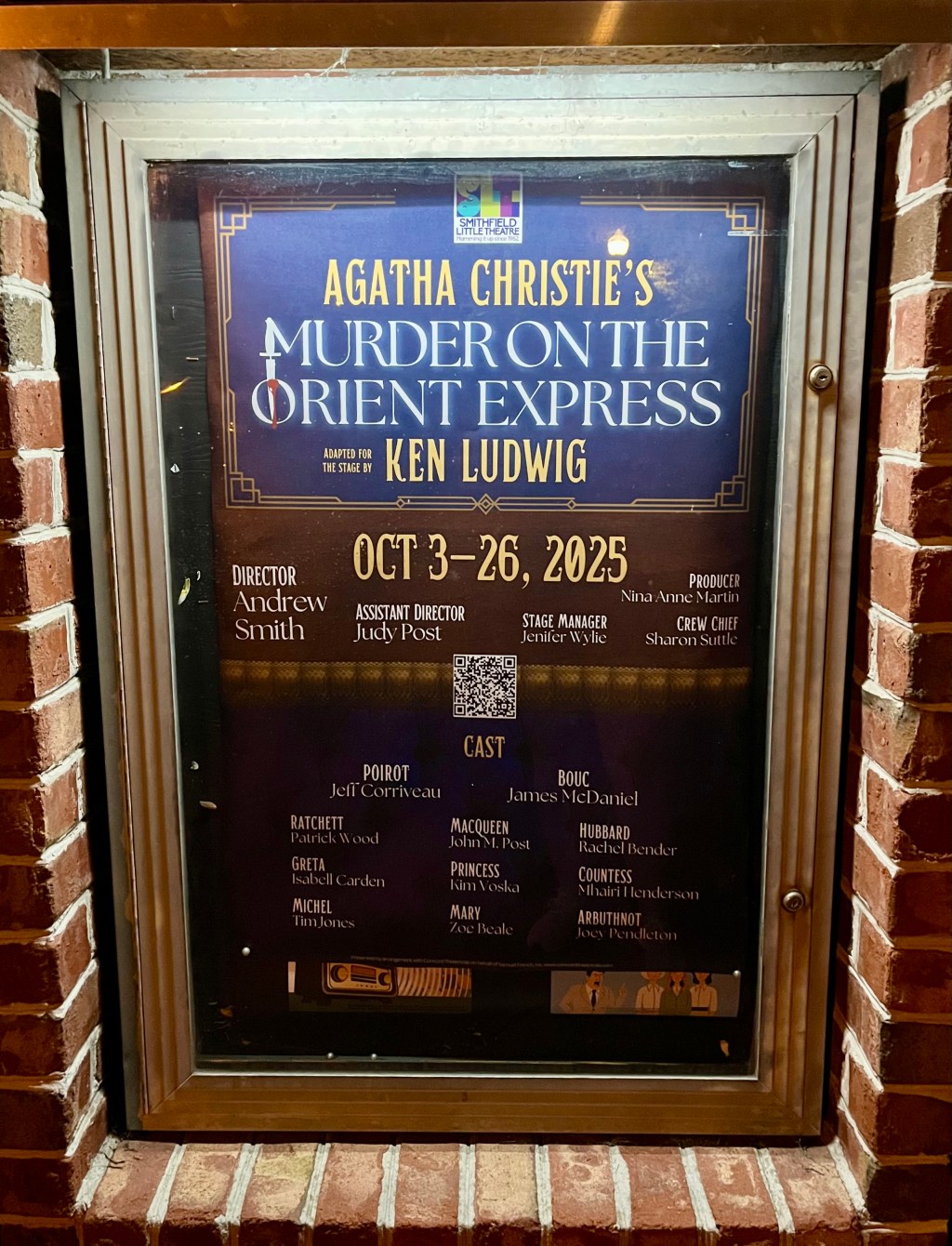
“The best food, the best beds, the best pillows, the best feathers inside of the pillows. It is poetry on wheels…” says Constantine Bouc, the man in charge of the Orient Express, as he sets expectations for famous detective Hercule Poirot (and the audience) for what they will see when the curtain opens. An ambitious promise, certainly, for Smithfield Little Theatre to sign up for when they announced their 2025-26 season opening show “Murder on the Orient Express”.
The music swells, and the curtain pulls away, revealing the work of set designers Andrew Smith and Robert Cox – and the audience can’t help but applaud, as ambitious promise becomes unforgettable reality. The fantastically conceived dining car sits in front of you, taking up every inch of the stage, with working interior lights, a beautiful little bar and luxurious table settings, and with those very familiar feeling train-style sliding doors. And then – as the characters start to move – SO DOES THE TRAIN! They have built a whole second car – a compartment car with three rooms – which slides onto stage as the dining car slides off, with a little area between the cars which is easy to imagine as being that small outside area between cars on a train, with that little railing keeping you from falling off onto the tracks. A magnificent setting for a (spoiler alert – but only if you didn’t read the show’s title on the marquee on the way in) murder to take place.
Unfortunate for the murderer is that Poirot happens to be aboard, with his eye for the slightest clue and ear for the whispered side conversation. Jeff Corriveau, taking on the role of Poirot, is everything that this “odd man with the silly mustache” should be. He is very convincing as he spryly pops around the stage once his interest is peaked, and you can’t take your eyes off him. He successfully works his interrogations in a very Poirot-way, gaining the trust of the individuals just enough to get the necessary info out of them. And he goes through the evidence at the end of the show thoroughly and with energy, such that his conclusions become clear just before he delivers them, without losing the audience’s interest. Corriveau is everything you could hope for from a Poirot, right down to the mustache-mask that he puts on as he goes to bed.
Of course, every Sherlock needs a Watson, to act as the audience, asking the questions necessary to explain the thought process. In this case, Constantine Bouc (the aforementioned Orient Express executive) fills that gap, and James McDaniel fits the bill beautifully. Bouc is always looking for the path of least resistance (and of the least bad press for his company), while giving Poirot a trustworthy assistant. McDaniel seems to embrace this customer-first approach, quickly flying around stage to tend to the various suspects’ (err… passengers’) needs at every turn.
The rest of the cast has the task of each being slightly suspicious to raise the intrigue of the audience, but not too suspicious (or too trustworthy) as to give away the ending. It is a real ensemble piece of work, and this ensemble comes together wonderfully. Patrick Wood’s Samuel Ratchett is disdainful as he bosses around his assistant, a frenetic John M. Post in the role of Hector MacQueen. Joey Pendleton’s Colonel Arbuthnot’s love affair with Zoe Beale’s nervous Mary Debanham leads him to feel overly protective when Debanham’s turn to be questioned comes up. Rachel Bender is hilarious as the loud-mouthed American Helen Hubbard, and her flirty interactions with the uninterested train conductor Michel, played by a reserved Tim Jones, are always entertaining. Kim Voska’s tough and unshaken Princess Dragomiroff is perfectly offset by the screaming, crying mess of a missionary that is Greta Ohlsson, played by Isabell Carden. And the beautiful Countess Andrenyi, she who catches the eye of Poirot, is a role masterfully executed by Mhairi Hendersen.
The show is given a cinematic flair by the sound design of Steve Clark and Andrew Smith, with an exciting soundtrack playing between scenes, and a lot of tight cues for sounds that needed to sync up perfectly with the action on the stage (executed quite successfully). And the stage was bathed in a well put-together light package by Z.F. Norris, whose blue and white speckled lighting felt right for a snow-blocked train, and red spotlighting was effective for murderous moments.
Much of the credit for the show coming together so well must lie with director Andrew Smith (yes, the same Andrew Smith credited with scenic and sound design – he clearly had his hand in most everything around the show). The feel and flow of the show was excellent, and I thought his blocking was strong, getting his actors in and out of their various train compartments in an effective and natural-feeling way. I was especially impressed (and was really hit by the detailed costuming from HRACT Award nominated designers Pam Revill and Elaine Brown) when at the end of the show, the entire cast is in the dining car as Poirot goes through the evidence and lays out his theory of who did it. The scene felt like a painting right out of a 1930s ad for an opulent train (of course, until you take the murder into account). But what’s a train ride without a little side plot, am I right?
This story is famous for being one of Agatha Christie’s best mysteries, but also for the moral questions it asks. What is justice in this case? Is justice, delivered outside of the law, ever a reasonable course of action? Poirot himself struggles with these questions, adding intrigue above the level of a normal mystery. You’ll have something to talk about after your trip on the Orient Express – so enjoy the ride!
 HRACT Awards