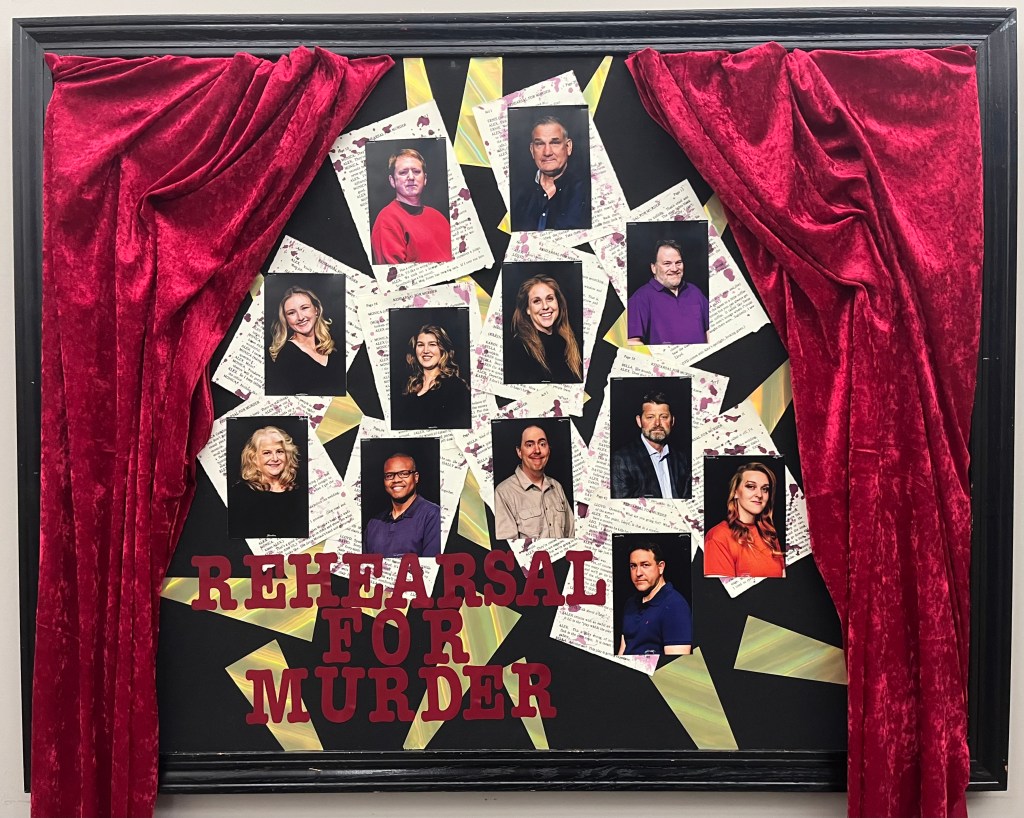
Theatre, at its core, is a game of imagination. You have a group of people – large or small – on stage, pretending to do something, and hoping that the audience is interested enough in the game to stay for a couple of hours. Sometimes, you add fancy sets lit by the most complicated of lighting packages for the audience to be wowed by, and sometimes, you add loud sound effects or even – get this – songs to keep the audience engaged. “Rehearsal for Murder”, playing now at Williamsburg Players, strips most of that away (save a few essential props and a perfectly executed if relatively simple lighting and sound package), and keeps the audience engaged with a cast of twelve of their best players, with minimal theatrical effects coming between us and the actors.
The mystery genre adds even another level to the game – where, as Alex Dennison, our leading man, says early in the show, “you take the audience by the hand and lead them the wrong way.” It is the cast and the audience, in an interlocked dance – the cast laying down a story, and the audience deciding whether they can trust that word, that story, that body language, that actor. This complex tango, with each side trying to feel out the other, relies on the actors taking the lead and bringing the audience along for the ride – each actor nailing their timing and their interactions, looking natural on stage, but also uncomfortable as the spotlight of suspicion takes its turn shining on each of them. Choreographing this dance is HRACT Award nominated director Carla Mutone, and she nails it. Mutone stages her scenes beautifully, slipping in and out of flashbacks seamlessly, with interesting blocking and effective use of the space.
And Mutone absolutely gets the most out of her actors, in one of the best acted shows we’ve seen over the last couple of years. That starts with Jim Dwyer, playing leading man Alex Dennison – a playwright who was engaged to Monica, the star of his new show, before Monica died (was it suicide or something more sinister?) exactly one year ago – the opening night of that new show, which was deemed a flop by the most important of critics. Dennison is convinced that it was murder – and so has gathered all of his suspects here, under the guise of a new play he has written, to try to get to the truth. Dwyer, who we loved a couple of years ago in “84, Charing Cross Road” (one of the shows that inspired us to create the HRACT Awards), is fantastic in this role. He is so compelling as a storyteller, leading the actors (and the audience) down the various paths to try to convince us that each character had a motive to kill Monica. He delivers his lines with utmost confidence and passion, nailing the emotions of every moment. You can’t take your eyes off of Dwyer as he slowly reveals all he knows (or thinks he knows) of the night of Monica’s death.
Dennison’s knowledge of each character’s movements on that night are revealed through a series of what are essentially “flashbacks”, at least as Dennison believes they happened. In those flashbacks, the deceased Monica is portrayed by another ACT-y nominee, Lyra Hale. Hale is always fascinating to watch on stage, as her particular way of moving, delivering lines, and interacting with her fellow castmates draws you into each moment wonderfully. She consistently has the audience considering what her character’s thought process is, and not just what the character is saying out loud – an uncanny ability which I’m not sure I can put my finger on exactly how she does it, but an ability every actor should strive for.
And then, of course, there is the raft of suspects. Justin Giroux is convincing as Lloyd Andrews, the director of the flop that Dennison wrote and Monica starred in, surely bringing his own real-life directing experiences to the role and how he interacts with his actors. Paul Lawrence is hilarious as the canonically “handsome and charming” leading man of the play-within-the-play David Matthews, bringing just the right amount of boozy-dizziness to the role to be believably hung over from his New York City clubbing exploits that feed his constant need for affirmation. Sam Miller as supporting actor of the play-within-the-play Leo Gibbs is upbeat and seems endlessly kind with an ability to get along with anybody, yet Gibbs is apparently divorced from Karen Daniels, Monica’s understudy in the play-within-the-play. Miller solves that apparent inconsistency with ease when you see how quickly he can snap back when Daniels (played by Alli Raymer) arrives, and the two of them start lobbing verbal assaults at each other. Raymer, for their part, does a wonderful job as Daniels, especially in a scene with Hale in Daniels’ dressing room, where they navigate the uneasiness of the conversation in a totally realistic fashion.
Katy Feldl, nominated for an HRACT Award this year, returns to the Players’ stage with a flourish as producer Bella Lamb, who maybe can’t handle the financial implications of a flop. Feldl brings a bit of an ego to the role (as any rich New Yorker might), is great in her interactions with the rest of the cast, and surprises us with the drama she is able to bring to an otherwise simple solo scene, taking her glasses off and having a one-sided phone conversation. Katie Griffith is the confident yet naïve secretary from Maine, delivering multiple hilarious lines, like when she assures us that she can handle putting out some coffees and Danishes (“I used to get A’s in home ec”) and when she finds a local she can relate to (“she’s like a real person, not like these New Yorkers”). And Jon Ward plays Frank Heller, the cop that Dennison has asked to secretly watch the whole evening (and maybe make an arrest), with the swagger and “nothing to see here, I’m in control” attitude you might expect from a police officer – and the ultimate surprise when he finds that he, too, is part of the audience and cannot control or predict the outcome.
Don’t get me wrong – I love the glitz and glamor of a show with a big budget, amazing set pieces, etc. But in a theatre named for its actors, Carla Mutone and the Williamsburg Players gave these particular players the stage and let them run with it. And we as an audience were the beneficiaries of that choice – playing a game of imagination with this set of talented actors, billed as a rehearsal, that we won’t soon forget.
 HRACT Awards