Photo courtesy of J. Stubbs Photography (https://jstubbsphotographyvb.com/)
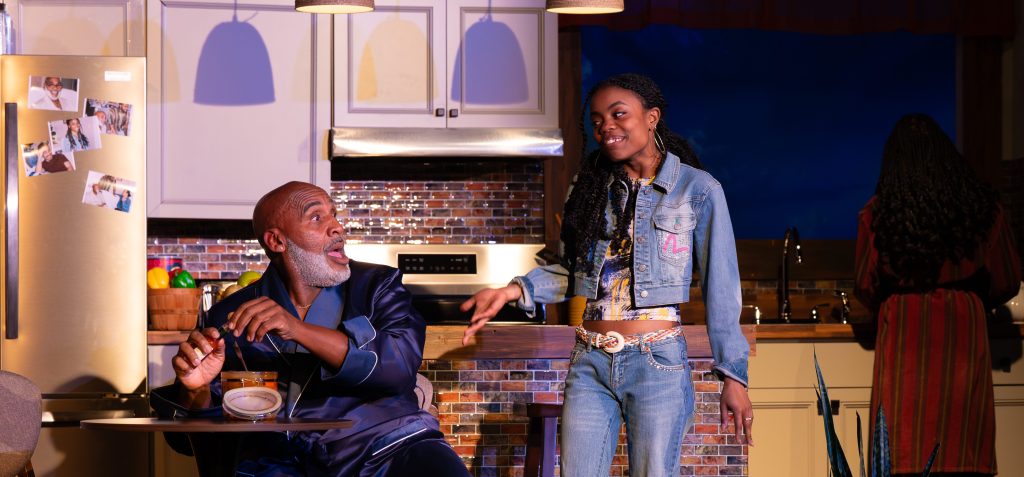
As the pre-snow cold bore down on Virginia Beach, we were welcomed into the warm and well-appointed house that is the set of LTVB’s show “Stick Fly”. Seriously – set designer Sandy Lawrence and Set Dresser Lisa Stafford should have a show on HGTV. The house they built on stage has a kitchen/living room set up that looks lived in and detailed, all the way down to a beautiful tile backsplash in the kitchen and a crystal candy bowl in the living room. They’ve even got three lights hanging from the ceiling (we are always keeping an eye on how many overhead lights LTVB has on a set, as there seems to be a tradition of always having at least one). This is a house that immediately says “upper class” – a house that might be using its various board games, tchotchkes, and a maid to hide the messiness of the family that lives there, and a house that might be intimidating to walk into if, for example, you had just gotten engaged to one of the children who grew up here…
And, of course, that is exactly what is happening. Taylor, played by HRACT Award winner Salem Rogers, has just gotten engaged to Kent, played by Yonathan Tekleab, and now Kent has brought her to his family’s vacation house to meet the family. Taylor comes from a much lower socioeconomic class (although her father is a famous author, her parents are not together, and her father fully chose his second family and is not part of Taylor’s life). Thus, she is particularly impressed by the house and its dressings – and Rogers and Tekleab have the immediate chemistry of a newly engaged couple.
What Taylor doesn’t fully know is that Kent’s brother, Flip, is also bringing his girlfriend (Kimber) with him to meet the family – and while Taylor might feel like an outsider since she is from a lower class, Flip’s girlfriend, while from the “right” socioeconomic class, is an outsider because she has a “melanin deficiency” – aka, she is white. Flip, played by Ra’melle Marshall, is quite nervous about introducing this fact to his parents, and the brothers seem to have planned this as a two-fer so as to try to diffuse any individual-specific tension.
As it turns out, the tension ends up coming from various unexpected directions. When Flip and Kent’s dad, Joe, shows up, his real beef is with Kent not using his various college degrees and instead writing a novel. Roger Wilson, as Joe, does a fantastic job of showing the intensity of fatherly manipulation, hidden behind a thick façade of joviality (and snacking on, of all things, pigs’ feet). Mom seems as though she is never actually going to show up for ambiguous reasons. Flip and Taylor apparently had a fling a few years back. And Taylor and Kimber (Kristen Martwinski, who we recently saw in “Crazy For You”) almost immediately don’t get along, with two competing worldviews (both of which have merit, and allow the playwright to explore classism and racism from multiple perspectives). Rogers and Martwinski do a fantastic job of creating the tension of such a conversation, with Rogers the more aggressive, appropriate for her profile of the challenger who is attempting to punch above her weight-class, socio-economically. Martwinski, on the other hand, is cool, calm, and collected, more adept at building rapport and consensus – skills learned through her Manhattan upbringing.
All this theory about structural classism and structural racism is great or whatever, but there is real work to be done – or so, I imagine, our third woman in the show is thinking. Cheryl grew up with this bunch as the daughter of the family’s long-time maid, and since her mom is sick (sounds like dying of pancreatic cancer), 18 year-old Cheryl has taken over the cooking, cleaning, and general upkeep of the house, constantly cleaning up after this very messy family – “well, it is nice for you to fill in” says Joe, his lack of asking after Cheryl’s mom being the perfect indication of how he feels about Cheryl’s place in the household. In the role is Destinee Kiara, who fastidiously works works works, from before the curtain where you can see her bringing in the groceries, cleaning up, and trying to get the blankets and pillows just right on the couch, all the way to and through intermission, constantly tidying, making coffee and sandwiches, all while fielding phone calls from her dying mother. Kiara is the surprising star of this show, as she adds a third circle to the Venn diagram of women in this show – each having certain qualities that make them insiders to this family, and each having certain qualities that place them squarely outside that elusive center. And Kiara’s emotional performance as Cheryl is remarkable, as she naturally converses with each of the other characters, and brings the explosiveness of an eighteen year-old just figuring out who she is and what she brings to this world.
Director ArLynn Parker leads a creative team that does a fantastic job bringing the show to life, nimbly moving the characters around the stage and feeding the audience this show’s societal points, while not allowing the characters to get too preach-y or losing focus on the familial plotline. In fact, the main questions I left the show with revolved around what family really means. Is it those you grew up with? Is it those you are related to? Is it those you choose as you journey through life?
Oh, and a feeling of thankfulness that my family isn’t quite so messy. At least, I don’t think they are. I guess we may never know.
 HRACT Awards