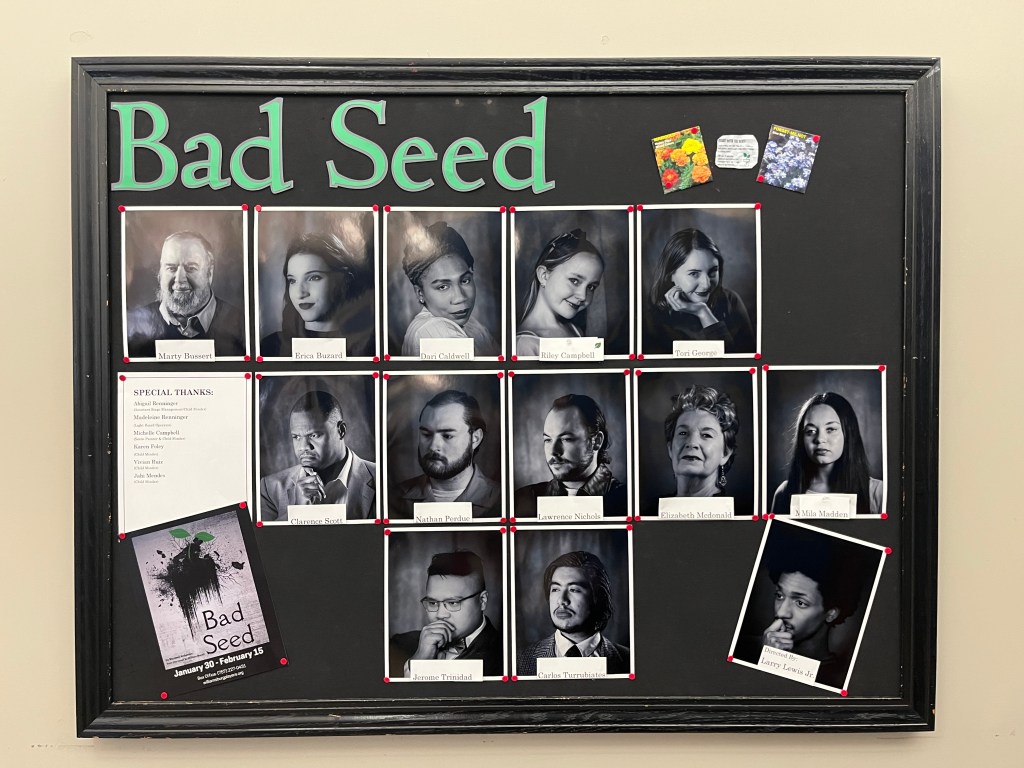
After a few starts and stops in my attempt to write a review of “Bad Seed”, currently showing at Williamsburg Players, I’ve concluded that is it just a difficult show to write about. Not because of any lack of skill, talent, or effort on stage or behind-the-scenes – this show had plenty of each. But because it is unclear to me exactly how much I might spoil when writing this. So be forewarned – I will steer clear of the ending, and try to tap-dance around some other plot points, but you are going to have an idea of the direction of the plot based on the below – so read with caution!
We get an open curtain as we walk into the theater, and so immediately begin to guess what may happen. There appears to be the set of a three camera sitcom TV show, with signs for “On Air”, “Applause”, and “Laughter” over top of a living room set-up right out of a 1950s upper-middle class apartment. It does feel a little bit uncanny – maybe a little too perfectly set up – but, that is kind of the vibe sometimes in a 1950s show. Nothing to see here…
We quickly meet our main family, comprised of Kenneth, Christine, and their elementary school-aged daughter Rhoda. As they tearfully say goodbye to Kenneth (Nathan Perdue), a military man who is off to his assignment at the Pentagon and will be gone for a month, their upstairs neighbor Monica (Elizabeth McDonald) pledges that she will be there for Christine and the wonderful, mature, cheerful Rhoda. In fact, we get our first look at that good-natured wonder of a daughter as she tries on a new pair of sunglasses that Monica gives her. Rhoda strikes multiple adorable poses, much to the delight of Christine, Monica, and the audience, and all is right with the world.
However, we quickly realize something is amiss, when in the next scene, Rhoda’s charm suddenly and completely vanishes as she has an uncontrollable tantrum over, of all things, a school penmanship medal, which she felt she deserved, but was awarded to a classmate, Claude Daigle. Then, we meet building maintenance man Leroy (one of our favorite local actors, Lawrence Nichols, doing his best Kramer impression as he walks into the apartment to a soundtrack of applause and his own piano riff), who suddenly begins speaking directly to the audience, as if he can’t trust anyone on stage with the information he has (or, at least, they won’t believe him). Nichols is fantastic in this smart-but-presenting-as-dumb role, acting as the common man and the only one with the common sense to see through the “acting” going on around him.
When Claude is found drowned at a school picnic, sans his prized penmanship medal, the true creepiness of this show begins to seep through, echoed by one very foreboding tone that musician Jerome Trinidad found on his piano on stage left. Christine’s suspicion is quickly aroused, and Dari Caldwell, in the role of Christine, begins to shine. Caldwell successfully navigates (err, doesn’t navigate) the emotions of wondering what may have happened – in fact, what probably happened – to Claude, but pushes forward in denial, unwilling to believe what appears so clear to the audience (and Leroy). And the show suddenly becomes about what Christine should do. She seeks advice, while not revealing any of her suspicions, from Monica (which McDonald plays with a very fun air of pomp) who fancies herself an amateur psychiatrist, from local criminologist Tasker (played by a straightforward and to the point Carlos Turrubiates), and from her own dad and newspaper columnist Bravo (Clarence Scott). She handles a visit from Claude’s sort of (okay, pretty darn) drunk mom, Hortense Daigle (an impressive cameo role from Tori George), about as well as she could. And she has to manage her interactions with Rhoda, who is just as charming as ever.
Rhoda is a shared role, with performances split between Mila Madden and Riley Campbell. We happened to see Campbell, and she was absolutely the star of the show. You couldn’t (and shouldn’t) take your eyes off of her anytime she is on stage. Whether she is tenderly stowing away a prized possession (“to keep a treasure so carefully is a kind of miserly delight”, says Monica of Rhoda’s safekeeping techniques), or opening her arms in the hopes of a “basket of hugs”, Campbell is always taking the lead in her interactions, and not to be trifled with.
“Bad Seed” makes no doubt about what side it takes in the “nature vs. nurture” argument. But then again – despite the loving and compassionate way in which this household seems to run, it does seem like Rhoda maybe gets everything her heart desires, which perhaps isn’t the healthiest way to be raised. So maybe it isn’t all nature after all? Either way, Riley Campbell’s sly smile to the audience as she hugs her stage mom is going to haunt me for days – and if I was her parent, I’m not sure I would feel comfortable with Campbell in my house for a few nights after that performance. I’m at the very least making her leave that costume at the theater to give me some separation from the character.
 HRACT Awards