Photo courtesy of J. Stubbs Photography (https://jstubbsphotographyvb.com/)
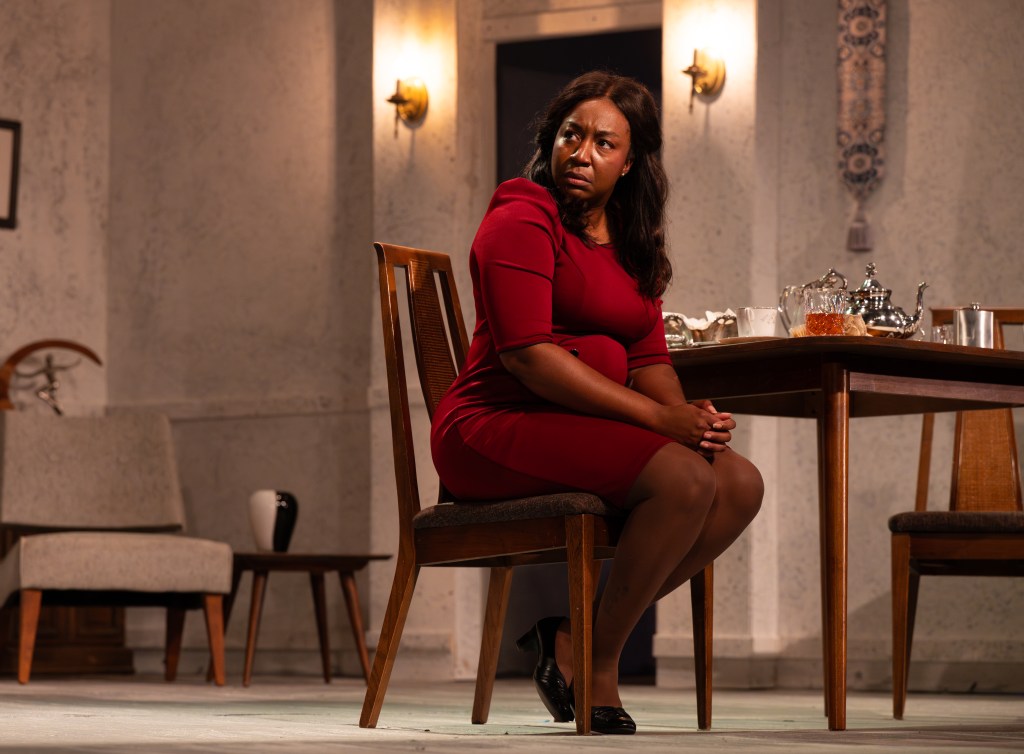
On a foggy March night, we were greeted by set designer Shawn Crawford’s sterile, white walls of a modern 1960s London residence on the stage of the Little Theatre of Norfolk, where the play “Angel Street” is currently playing. And something felt just a little… off. Is it the couch, placed uncomfortably close to the fireplace? Is it the chairs with backs reminiscent of metronomes, but whose pendulums have seemingly stopped? Is it the fully drawn curtains, completely concealing the inside world from the outside world? Is it the gas lights on the walls, which, we will soon discover, quietly but importantly fade in and out, a well-executed trick by lighting designer Derrion Hawkins?
Mr. Manningham – our leading man – quickly identifies what he sees as the problem – a picture has been taken off the wall. And so his wife is subjected to his line of increasingly aggressive questioning – and the audience has to decide whose side of the story is true. Is Mr. Manningham a frustrated husband, whose wife is somewhere between paranoia and losing her mind, who perhaps isn’t dealing with that productively but is doing his honest best? Or is Mrs. Manningham an emotionally and physically abused wife, being gaslighted into thinking she is crazy by her husband?
Perhaps this show’s original title of “Gaslight” will give you a clue as to what is real. But even the fact that you for a moment have a seed of doubt should give you pause, as you recognize the dysphoria that can come from not being believed and constantly being told that something different from your reality is the truth. A very pertinent subject that holds up almost 90 years after the original production of the show.
Sheryl Harris, playing Mrs. Manningham, is the engine at the heart of this show, and she is wonderful. Harris’s character has the nervous energy of someone always trying to please from the opening curtain, and, for a while, it is unclear if it is an inner or outer demon (or both) that she is looking to pacify. Her emotions are obvious but her interactions are subtle, getting the most out of a glance here and a small touch there, and working the script into her natural cadence perfectly.
Meanwhile, Jamie Turnbull is intimidating as he talks round and round, flipping the key to his desk in his hand over and over, showing how he is in control, and leading each conversation to his predetermined end. Turnbull also very successfully uses his physical demeanor to tell the story and indicate his power in the relationship, consistently disguising his menacing touches as tenderness towards his on-stage wife. When Mrs. Manningham tells Mr. Manningham that “you should have been an actor – you were cut out for it”, the audience should listen. Actors are great liars – and so is Mr. Manningham.
Bringing his air of grandeur immediately upon entering the stage is James McDaniel V as Sergeant Rough, a local retired policeman who believes there is a cold case to be solved in this very house. McDaniel brings a much needed bit of levity to the show, telling of his exploits, asking for (many) extra lumps of sugar in his tea, playing a game of peekaboo with his bowler hat, and wearing “quite a saucy shirt, don’t you think?” He slowly gains Mrs. Manningham’s trust, and although he does seem to care more about solving this case than about her at times, he is an important ally to the woman of the house.
Another important ally is housekeeper Elizabeth, played well by Nairobi Brown, who discreetly helps Mrs. Manningham in the small ways she can. The other in-home staff person, maid Nancy, has chosen the other resident as her favorite. Corey Hinson takes on this role of a lustful 19-year-old who loves the drama of the moment, has a crush on her boss, and is intriguing (to Mr. Manningham, at least) with her attitude and flirtatious body language.
The credit for the strong casting of this show must be given to director Isis Marné. She gets her actors to fully live the moment, losing themselves in the characters, while not over-acting. The facial expressions and small movements and gestures from the cast define the relationships between the characters in a show so driven by unspoken and shifting power dynamics, and Marné got those to flow beautifully and naturally, a very successful directorial debut.
The question in the final scene: will Mrs. Manningham finally see through this fog? In a moment of clarity, she indicates to Mr. Manningham an understanding of the physical item she is holding (and the entire situation), ultimately taking charge and standing up after having been told to sit down countless times by the men around her. A powerful moment punctuating a powerful performance by Harris and the entire cast, which will compel you as an audience member to stand and applaud this strong woman and those she has survived with and survived from.
 HRACT Awards