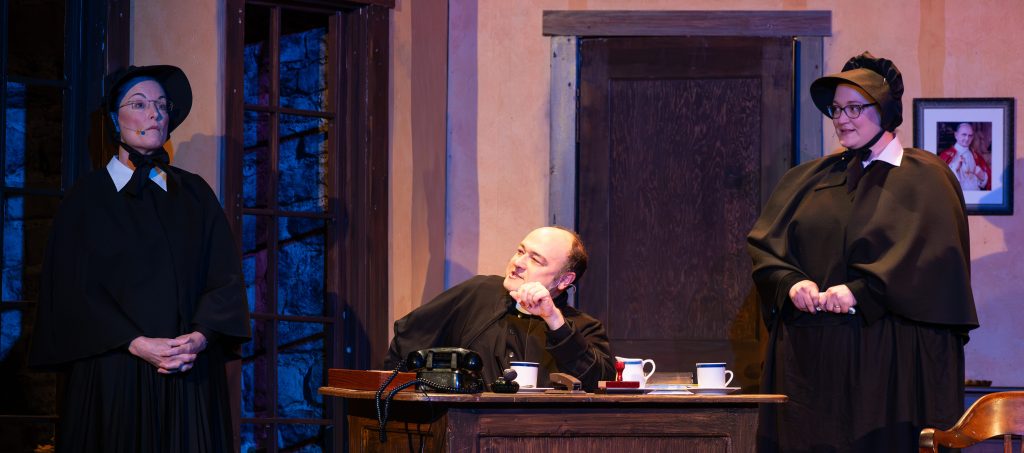
Photo courtesy of J. Stubbs Photography (https://jstubbsphotographyvb.com/)
“What do you do when you are not sure?” asks the first line of “Doubt, A Parable”, playing now at the Little Theatre of Virginia Beach. It is uttered by Father Flynn from his pulpit, ironically the only character in this show who can be sure of what he did (or didn’t) do when he had a private meeting with a 12-year-old boy, the only black child in the Catholic school Father Flynn’s parish is associated with. For the next ninety minutes, director Maryanne Kiley’s cast shows us different answers to that question – and the audience is challenged to consider which set of actions is most moral, most appropriate, most… holy.
Kiley has made a habit (excuse the nun-pun) of consistently impressing us with the emotional performances she gets out of her casts combined with strong technical elements (see – three-time HRACT Award winner “Indecent”), and this show is a perfect embodiment of that. The cast is magnificent, led by Regina Rossi as the stern, tough-minded Sister Aloysius. Sister Aloysius is the principal of the school, traditional in her beliefs (see: the unpopular take that Frosty the Snowman and his magic hat are sacrilegious), stubborn and sure in her convictions, tactical in her thinking, and willing to do anything to “keep the wolf out” of her school. Rossi is fantastic – just one look into her eyes and you can feel the tension, see her power, and comprehend the emotions this character is feeling. The audience understands that Aloysius has to look out for the good of the entire student body. Unfortunately, that comes into conflict with the needs of the individual when she meets with the potentially abused boy’s mother, Mrs. Muller, played by an appropriately uncomfortable Cynthia Tademy, who is attempting to take a practical, long-term outlook, informed by her experience as a black woman in 1960s America.
Meanwhile, Liz Brydge is Sister James, the foil to Aloysius’s certitude. Sister James is an idealistic educator, someone who wants to inspire the children and ensure they feel like they can talk to her – which Aloysius quickly shuts down with a snappy “they are children – they can talk to each other.” Brydge plays this innocent character with such sincerity that, as the gravity of the situation weighs on her, your heart can’t help but break. Her attempts to find an easy off-ramp are relatable but ultimately doomed, and the journey to get there is devastating in the hands of this fine actress.
And then, there is Samuel Flint, perfectly executing the role of Father Flynn. He delivers a sermon with vigor, defends himself while attempting to not come off as too defensive, is evasive with his eyes but strong with his words. As the pressure gets to Father Flynn, Flint’s conversation style begins to move more quickly, the words tumbling out of his mouth like a man in turmoil, with no respite being offered from Rossi’s Aloysius, and only a kind smile from Brydge’s James to cut the stress.
Supporting this top-notch cast is a technical team equally up for the task. Sandy Lawrence’s set is designed perfectly to keep the momentum of the show moving with no changes necessary, with stained glass overlooking a beautiful lectern, an appropriately modest office for Aloysius with windows into a garden, and a little outdoor prayer path. Sabina McManes’s lighting design is stunning, with colors mimicking the stained glass for the church scenes, slight variants to reflect the tension of the moment, and different lighting for outdoor versus indoor scenes. And, Jon Vredenberg surprised us with his notable sound design. As somebody who in their youth spent many a Sunday morning in a Catholic Church, the reverb from the pulpit was immediately recognizable, yet not distracting. The choir of nuns mixed well, and the sound throughout was spot-on.
As the audience, we yearn for a clean and clear answer to the question of guilt: a storyline we can cling to, some piece of evidence that condemns or absolves, a Sherlock Holmes or a Miss Marple to explain all the circumstantial information and tie it neatly in a bow. Our very nature hates to live in the purgatory of the unknown – and yet, that is where author John Patrick Shanley keeps us, at least for the majority of the show, and in many ways still as he dumps us back out of the controlled world of theater and into the uncontrollable maze of reality. The guilt or innocence of the party at hand is, from my standpoint, somewhat obvious, although from the reactions of the rest of the audience, it would seem to be less so to others, and thus I commend that question to you. What I find the more interesting query is – did the actions that Sister Aloysius took, and the results of those actions, lead to a safer environment, a safer world? That is the doubt that I believe enters her mind at the end of the show, as her tears drop and the curtain falls. A moving and thought-provoking performance, this group deserves the standing ovation they received – of that, I have no doubt.
 HRACT Awards