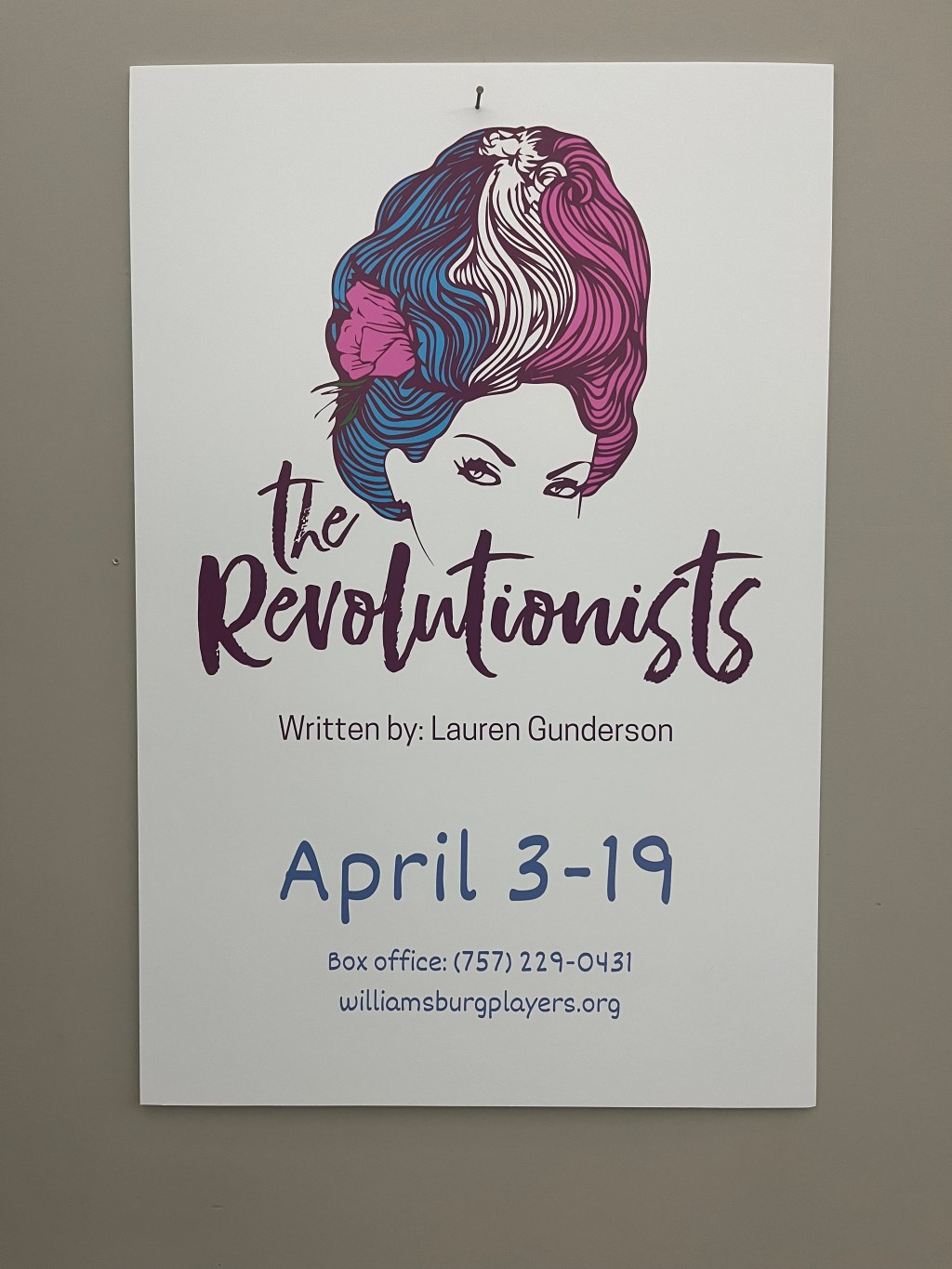
“It might be fiction, but it is not fake.” A few days after seeing “The Revolutionists”, playing now at Williamsburg Players, I keep coming back to this line, said multiple times throughout the show. In a world that is stranger than fiction at times, it was this line about how art can feel more real than reality, how a play can speak larger truths than a true story, how an imagined character can teach us more than an actual person, that rang most true in this show.
Embodying that line is our leading lady, Olympe de Gouges, the French playwright and feminist revolutionary. It is in her mind that this show takes place, where de Gouges seems to be encountering some kind of writer’s block, and has turned to imagined versions of assassin Charlotte Corday (the woman who assassinated radical French revolutionary Jean-Paul Marat), Marie-Antoinette (yes, the queen of France herself), and Marianne Angelle (a fictional black woman championing the rights of slaves in Haiti) to help inspire, or at least distract, her.
I can tell – just from my quick descriptions, you are getting nervous about having not paid attention in your 10th grade European history class. But don’t worry – you don’t need to be an expert in the French Revolution to understand the situation at hand. No – the atmosphere that surrounds the Reign of Terror will be made glaringly obvious by the impressive and intimidating guillotine looming over every moment of these women’s conversations, with basket prepped and ready to catch heads as necessary. The rest of the set is simple yet effective, with only one (very quick and seamless) set change necessary, well-designed by Justin Giroux. Giroux is also the director of the show, and he keeps the momentum of the show up throughout, with fast-moving and meaningful dialogue (but pausing every now and then to bring the fun).
Who better to bring the fun to the French Revolution than the Queen herself, Marie-Antoinette? Sarah Faber-Catanese does her best Jane Krakowski on “30 Rock” in the role – and absolutely nails this dumb but profound version of the monarch. Faber-Catanese had us laughing all night – and will have you wondering where she keeps finding more and more emotional support ribbons. She has impeccable timing in delivering her lines – including when she exclaims “I made a touché? I’ve always wanted to do that!” And her big (but quick, so don’t blink) smile when she finally gets that mint open is worth the price of admission all on its own.
In stark contrast to Marie-Antoinette’s ditzy light-heartedness is Charlotte Corday’s intensity. Corday’s clarity of motive and certainty in her actions is admirable (if the actions themselves are perhaps less so) – and actress Alexandra Ebbs is somehow able to reflect that certitude in her vocal affect and decisive movements. She has no time for stories, convincing people, or beating around the bush – Corday demands action, and demands it now.
Ready to jump into action, but with a deeper understanding of the need to change hearts and minds, is Ashley Williams as Marianne Angelle. In her bright white dress with a sash proudly decreeing “Revolution For All”, Williams’ eyes light up with energy and excitement when she talks about her cause of bringing the values of the revolution to her Haitian enslaved brethren (and sistren). Her confidence is palpable, her societal points sharp, and her thirst for equality insatiable.
With these strong and confident women around her, de Gouges, portrayed by Rebecca Weinstein, is constantly reminded of her own fear. Weinstein gets the nervous and frenetic energy of an artist running out of time and unsure if she has done or accomplished enough, or anything at all, just right. Her internal struggle, impressively portrayed, is also one of ego – is she important enough as a writer to have it mean something if she gets killed for her political stances? Or is she important enough as a writer that she must live to be the voice of the revolution? To the end, de Gouges is the defender of art, fervently arguing that theater is a key way to tell the stories of the people and further the purpose of revolution – more convincing than a pamphlet and more lasting than one single action.
Not to be lost in the shuffle, costume designer E. Katherine Hargrove (and an entire army of helpers after she had emergency hand surgery) did a wonderful job outfitting these women. Whether intentional or not, we found meaning in the individual colors each actress wore – the white of equality for Marianne’s push for all races to be included in the revolution, the blue of liberty for Charlotte’s moves against the most radical factions of the revolution and their summary executions of prisoners, and the red of fraternity (or, in this case, sorority) for Marie-Antoinette’s ability to connect with and comfort the characters individually (despite being perhaps the least likely person in the world you would expect in that role). Oh yeah – and Marie-Antoinette’s very, very tall wig, rivaled only by the guillotine on stage in terms of height, wins a shout-out for wig dresser Edith Broward-Edds as well.
And finally, there is de Gouges, dressed in a mix of all three colors, as she attempts to incorporate a bit of each of the other women into her most important, and final, moments. As each of these women emotionally come to grips with their fates, they realize something – while they are willing to die for their ideals, they don’t want to die for them – they want to live for them, and for each other. That sounds like a revolution we can all get behind.
 HRACT Awards