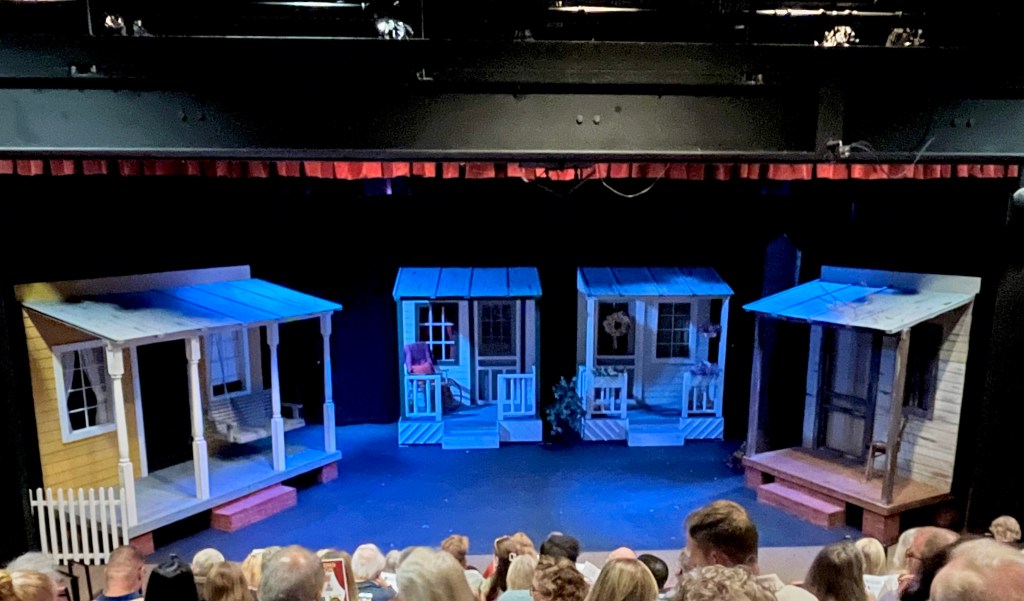
At some point in childhood, your understanding of the world begins to shift from that of a series of tall tales and lessons you have been taught to seeing the place as it is – with all its problems, but also all the good it can offer, in plain view. It is in this moment of life that “To Kill a Mockingbird” (now playing at Smithfield Little Theatre) takes place for Scout; a wonderful moment when the legend and mythology of the recluse of your town can live in your mind right alongside a fledgling understanding of the reality of the situation. This tug-of-war between childhood and adulthood is also where you start to recognize your parents as people, with lives and personalities that don’t fully revolve around you, and a whole lifetime of experiences and relationships from before you were even born.
Part of the magic of Harper Lee’s book is in getting Scout’s perspective in that moment just right – and so the charge moves to young Abilene Lamun, taking on the role in this production. Lamun’s Scout is excitable, and nervous, and self-assured, and just believably a kid – and pushes through the many, many lines of dialogue entrusted to her quite impressively. Playing off Lamun are two more products of SLT’s summer youth program in Cooper Garrett as older brother Jem and Mycroft Agnew as friend/sort of adopted sibling Dill. Garrett does a good job of feeling the weight of being the older brother – and in some ways, also feels as though he has to stick up for both Scout and his dad, when his dad declines to “fight back” in the way that Jem feels is appropriate. And Agnew – dressed in some of the highest-waisted shorts I’ve ever seen (amusing and just right for the part) – plays the role of Dill with a straight dead-pan affect, a nice foil to the often-driven-by-emotions Scout and Jem, and funny as he logics his way to using a line of lemon drops to try to get Boo Radley to emerge from his home.
What the three kids get most right, however, is their nervous respect, and yet comfort and trust, in their interactions with Atticus (Scout and Jem’s dad). Atticus Finch is played by Bob Cohen as strong-willed and stubborn, in all the best ways; tough but understanding with his children, polite but firm with his peers. When Atticus, a lawyer, is entrusted with defending a black man (the honest and kind-hearted Tom Robinson, played by Robert Hughes – who is able to persuade the audience of his outward calm and yet inward anxiety in the face of it all) in court for a crime he is accused of committing against a white woman (a very nervous Mayella Ewell, played by Gabriella Meier), he knows that he and his children are likely to become pariahs in the minds of much of their community. But Atticus also knows that his conscience would never be clear if he doesn’t do his absolute best in defending his client – and that he must set an example for his kids of seeking the justice that the courts promise. It is hard to imagine a better example for a group of children, as Cohen, turning red as a beet with emotion, delivers his impassioned closing argument to the jury, the audience hanging on his every word – I’m not sure the SLT theatre has ever been so still and focused as it is in that moment.
It is Atticus’s unending belief in humanity that drives his relationships forward. He picks the people he trusts well, starting with his relationship of respect and friendship with Sheriff Heck Tate (the compelling Forrest Short, whose convincing dialogue and interactions with the other actors absolutely stands out throughout the night). He is nothing but kind and respectful to Calpurnia (a well-executed if much-abbreviated-from-the-source-material role for HRACT Award winner Chasida Taylor), his trusted maid, cook, and surrogate mother to the kids. Despite her clear prejudices, Atticus forces Jem to spend time with Kim Voska’s Mrs. Dubose (a role which Voska nails with real get-off-my-lawn energy) to help Jem learn about meeting people where they are and seeing things from their points of view (even if their points of view are wrong). And he is somehow civil and level-headed in his interactions with Bob Ewell, an about-face of a role change for Mark Glickstein from his recent HRACT Award nominated role in “Puffs…”.
In this town full of tall tales (often spread by the town gossip Miss Stephanie, played by April Watkins), and in this story (narrated well by Jenn Melms in the role of friendly neighbor Miss Maudie) about learning to look past those tall tales to the truth of the matter, it is up to the jury to decide if they will continue to believe white America’s favorite terrible tall tale of the time, protecting their own child-like worldview and self-interest, or turn towards truth and real justice. Director Warren Johnson stages the courtroom (which, by the way, comes to life with a quick spin of two of the four porch-fronts which create our rural Alabama town on stage with no break in the action of a show, a nifty trick designed by Robert Cox) with the audience as the jury, making you the decision-maker, forcing you to consider the implications of your thoughts and actions on others.
Driving home after the show, my wife was telling me about her first time reading the book – when she was in late elementary school – and having the same reaction as Scout, Dill, and Jem to the court proceedings. She in fact charged into the house the day she finished the book, crying to her mom, saying “you said this was a good book!” to which her mom replied – “this is exactly why it is a good book.” The fact that this story, set in poor, rural 1930s Alabama, and released in 1960, can still elicit such reactions and make such strong and relevant points today is a testament to its greatness as a literary work, but also an indictment of the problems that persist in our society today. If you haven’t read it – read it. And if you get a chance to see it – see it. You won’t be disappointed.
(New this season, our wonderful cat Pepper wanted her voice heard as well, if you all will oblige her…)
Pepper’s Purr-fect Picks: The message is wonderful, but I can’t get behind shooting a dog, even if it is out of compassion. No paws up or down!
(Pepper also canonically sells concessions at the various community theaters. She always comes up with a themed drink special, which is for entertainment purposes only and notably IS NOT in fact available for purchase)
Pepper’s Drink Special: “The Scout’s Honor” – a half-lemonade, half-fruit punch. A simple drink for a simple (yet complicated) time.

