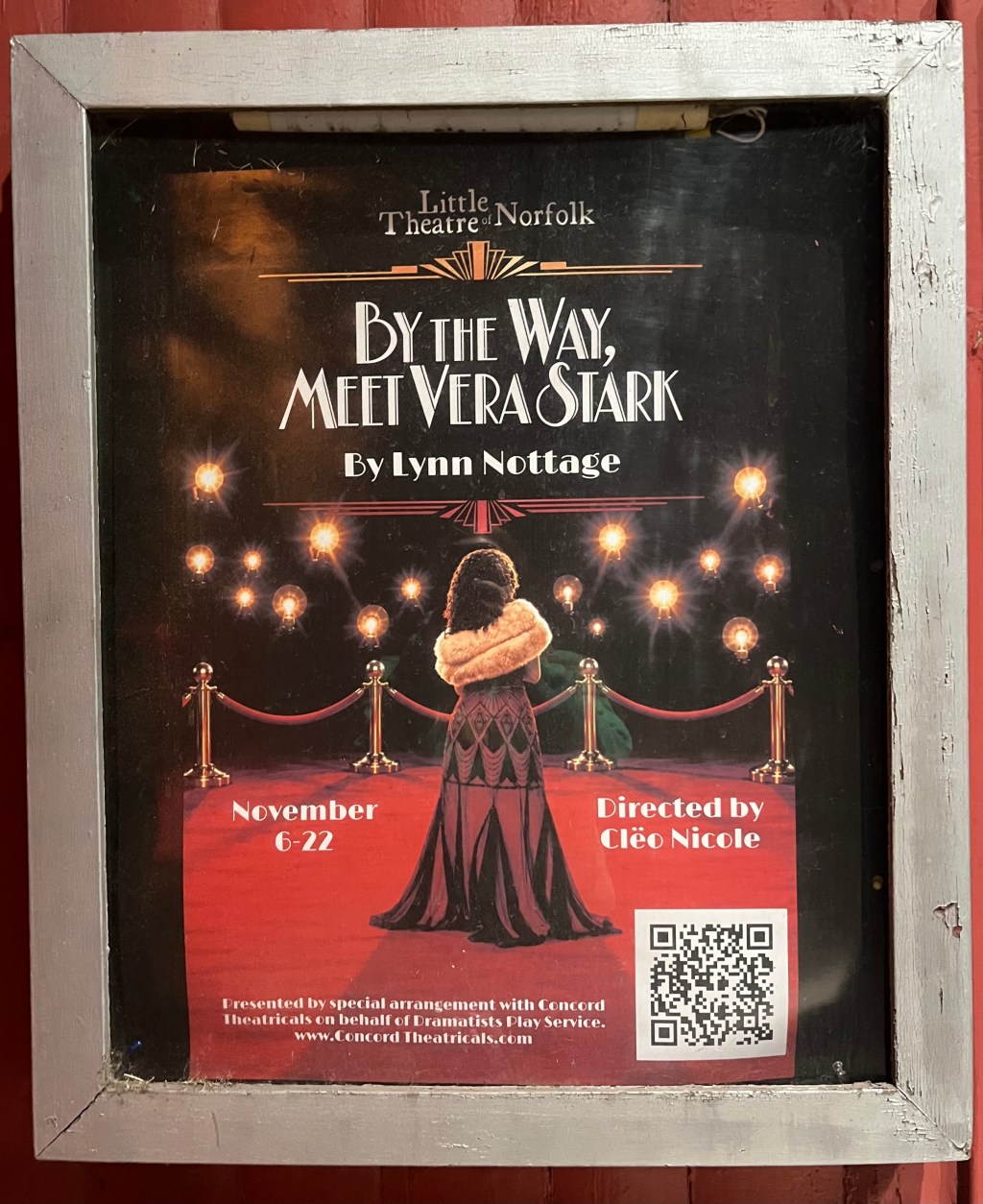
A month ago, I had no idea how much time I would spend thinking about “Gone with the Wind”, the 87 year-old film with some (err, many) complicated legacies. And after getting a perspective on one of the most famous re-writes in Hollywood history at PCT’s “Moonlight and Magnolias” a few weeks ago, this month Little Theatre of Norfolk takes on a humorous and fictionalized version of the casting process for a big budget southern epic (called “The Belle of New Orleans” in this imagined version) in the first act of “By the Way, Meet Vera Stark”.
We meet Vera Stark, dusting nothing in particular, as she runs lines with her employer, the famous starlet of the screen Gloria Mitchell. Vera, despite being presented to us as just the black maid for the white Gloria Mitchell, is willing to push back on Gloria and give her some “tough-love”, as Gloria is nervous about her upcoming screen test for the lead role in “The Belle of New Orleans”. (The young Gloria is played with dramatic flair and Hollywood carelessness by Emily Dollenmeyer, a well-performed caricature of what fame in the 1920s was for white people.) It is obvious from the moment Vera is on stage, though, that she is a massively talented actress in her own right – and, despite her previous declarations that she wouldn’t be pigeon-holed into playing enslaved characters in the Hollywood of the early 1900s, she is clearly looking for a break-out role, even if it is serving a white character on-screen.
In the role of early-career Vera Stark is Aries Donaldson, who is truly excellent throughout. Her ability to portray both the stereotype of what Hollywood was looking for in a black actress at the time, as well as providing some pushback on that as a trope, is remarkable. She believably engages in conversation with the rest of the cast, and clearly portrays Vera’s passion for performing – see, for example, a moment in the show where she is in the middle of taking her shoes off, hears a song on the radio that moves her, and starts dancing with one shoe on and one shoe off because she just can’t hold back her passion when it hits her. Or, when Vera is telling her slightly older and wiser roommate and friend, Lottie, what she is hearing about the casting process for “The Belle of New Orleans”, she looks back and forth dramatically when describing how the powers that be want to “make a discovery” in casting the enslaved black role. Or, when thrust in front of the director, Vera can hardly hold it together as she convincingly portrays herself as the epitome of hard-luck black America, winning the part, as well as a rare mid-scene ovation from the audience at LTN for Donaldson’s work.
Writer Lynn Nottage’s script, under the direction of Clëo Nicole, has a way of toeing the line of being completely hilarious while making a point throughout the entire show, and the epitome of that is Jeanessa Loyd’s Lottie. Lottie is a walking satire, constantly pointing out truths about people and society in humorous ways, as she vocalizes all of her secret (and not-so-secret) vendettas. I always wanted to hear what she was thinking because she was going to tell it like it is, and make you laugh – like the friend you have with the sharpest wit who is also just about the smartest person you know. And Loyd absolutely knocks the role out of the park.
Meanwhile, the less-put-together third roommate of the group, Anna Mae, is attempting to borrow things from the other two for her date. Come to find out, Anna Mae, also African American, is pretending to be Brazilian to wriggle (literally at times) her way into the upper echelons of Hollywood society – and when we got the chance to see Connie Tate do her over-the-top Brazilian accent and performance, we couldn’t stop laughing. And Ra’melle Marshall plays Leroy, the driver for the director of “The Belle of New Orleans”, with nervous yet confident energy – something that sounds impossible, but you’ll get it when you see him constantly standing slightly closer to Vera than might be considered polite.
The first act, to me, is the more interesting story, but the second act, where we are thrown into an early-2000s discussion on the legacy of Vera Stark, is fascinating conceptually, throwing all sorts of context at what we saw in the first act, while also critiquing how historians and storytellers twist legacies and make them fit into the box they are looking to fill. The second act introduces three new, more modern, black tropes, that of the nerdy and somewhat (maybe intentionally) disheveled-looking Oakland-based filmmaker Herb (a second role for Ra’melle Marshall), the poetic lesbian revolutionist in Connie Tate’s Afua, and the didactic and intellectual professor Carmen played by Jeanessa Loyd. They begin by watching the final scene of “The Belle of New Orleans”, and we get one last look at the young Vera and Gloria in their most iconic film moment. Then, we watch “found footage” of Vera’s last interview before disappearing from public life, forty years later on a 1970s talk show (hosted amusingly if intentionally ineffectively by Nathan Connolly’s Brad, and interrupted by the funny and stoned rocker Peter, a bit part well executed by Jasito Pérez).
In that interview, an older Vera is played by HRACT Award-nominated actress Sheryl Harris, and an older Gloria is played by Kathy Hinson, an HRACT Award winner. What impresses me most about this portion of the show is the abilities of these two actresses, in addition to director Clëo Nicole, to make them feel like the same people played earlier by Donaldson and Dollenmeyer, with similar mannerisms and cadences in their speech. But, Vera has clearly developed as a character and person, with more nuanced views of the world, although still with the same passion in her eyes, while Gloria has somehow stayed almost exactly the same, fighting to stay relevant in society, and still (although more subtly now) treating Vera as beneath her.
The other impressive work in the second act comes from set designer Shawn Crawford, whose set is sneaky good in the first act but truly shines in the second act, with a fantastic couple of floor-to-ceiling windows coming down from the sky with a huge chandelier to create the iconic southern movie scene, and a very groovy setting for the 1970s talk show. Also shining in the second act is Chris White’s lighting design, where his distinct lighting for different levels of the stage really helps the audience understand what they are watching in terms of “old footage” versus “happening in present day”, something that could have been confusing. And costume designer Chelsie Carledge-Rose gets the outfitting just right, with each costume being effective at letting you know about the character, or stereotype they are portraying, or their station in life, before they even have any dialogue.
“History is a question constantly being rephrased” surmises Marshall’s filmmaker character late in the second act. And that, it seems, is especially true for Vera, whose disappearance from public life allowed others to take a hold of her legacy, without having the actual individual there to steer the discourse back to “true north”. This show makes you think not only about how early Hollywood treated black actors, but also about how later biographers and contextualizers may not always get it right (and that includes you, as an audience member, and how you are always filtering history through your own lens).
(New this season, our wonderful cat Pepper wanted her voice heard as well, if you all will oblige her…)
Pepper’s Purr-fect Picks: A lot to unpack with this one, but notably no cats. As someone who watches a fair amount of TV and movies while my family is at work, I do enjoy a good “making-of” story – although my favorite thing to watch is tennis, which this is not. One paw up!
(Pepper also canonically sells concessions at the various community theaters. She always comes up with a themed drink special, which is for entertainment purposes only and notably IS NOT in fact available for purchase)
Pepper’s Drink Special: “A Magnolia Mimosa” – (although since Pepper only sells virgin drinks, this is just an orange juice with a flower petal on top).

